

How Does Multi-CDN Improve Fault Tolerance in Networking?
Multi-CDN improves fault tolerance by giving your traffic more than one healthy path to the edge. You run two or more CDNs in parallel and steer users to the one that’s healthy right now, so a regional outage or routing problem doesn’t become your outage.
Why Multi-CDN Improves Fault Tolerance
Fault tolerance is one promise: a single failure should not take your service down. With a single CDN, the blast radius is bigger than people expect. Even if the provider is technically up, parts of the network can be broken: one PoP is overloaded, one ISP path is congested, or a new ruleset causes errors.
A multi CDN strategy helps because:
- Redundancy: another edge network can serve the same hostnames.
- Diversity: different PoPs, peering, and capacity means failures don’t line up perfectly.
- Steering: you can shift traffic by region, ISP, or endpoint instead of waiting.
I treat multi-CDN like a circuit breaker for delivery. You isolate the fault, keep requests flowing, and buy time to fix the root cause.
Common Failure Modes You Avoid
Most CDN incidents are partial. That’s where a multi CDN solution earns its keep.
The main win is simple: you stop relying on one provider’s end-to-end health.
Multi CDN Architecture In Plain Terms
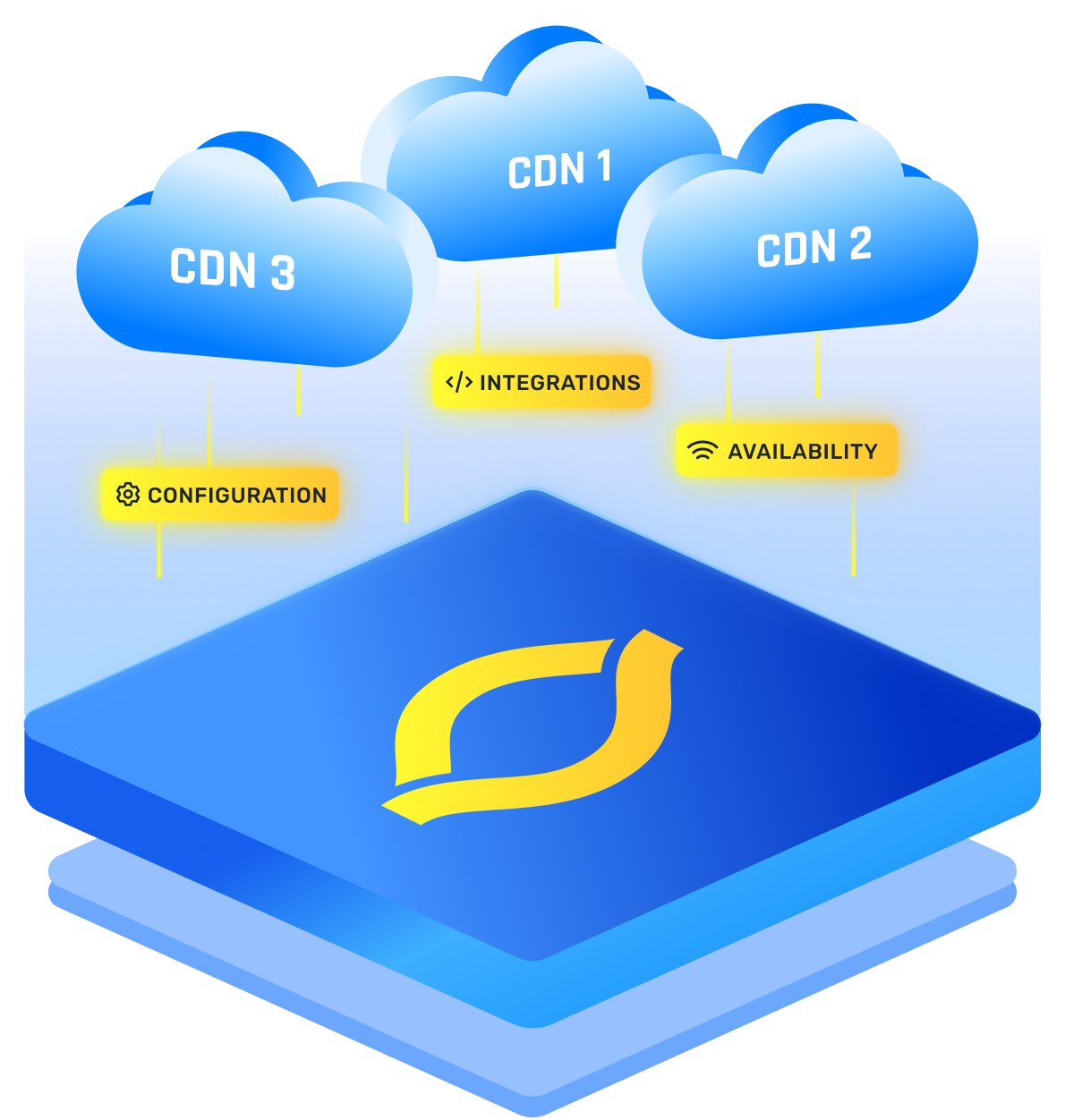
A practical multi CDN architecture has four layers:
- Origin: your app, storage, and APIs (ideally multi-region).
- CDNs: two or more providers serving the same domains and cache rules.
- Steering: the logic that decides where a user goes.
- Observability: signals that tell steering what’s broken.
For real fault tolerance, CDN B can’t be a forgotten standby. Keep certificates current on every provider, and make sure both CDNs can reach your origin with the same headers and firewall allowlists.
Traffic Steering Options That Actually Work
There are a few common steering patterns. Each trades speed for simplicity.
If you want a safe starting point, DNS steering plus good monitoring is usually enough. If you need faster reaction than DNS allows, hybrid approaches are where most teams land.
What Should Trigger Failover
Failover needs objective signals. You’re asking: “Is this CDN safe for these users right now?”
Signals that work well:
- Availability: edge 5xx rate, timeouts, DNS failures, TLS handshake failures.
- Performance: TTFB, p95/p99 latency, key page load time.
- Security and saturation: WAF events and rate limiting spikes.
- Origin stress: origin errors, connection exhaustion, cache miss bursts.
Scope matters too. If only one country or one ISP is struggling, steer just that slice. Use thresholds that avoid flapping, so you don’t bounce users between CDNs every few minutes.
I prefer combining synthetic probes with real user monitoring. Probes give early warning. Real user metrics reveal ISP-specific pain that a single probe location can miss.
What A Good Multi-CDN Failover Looks Like
Multi-CDN improves fault tolerance most when failover is predictable.
- Detect: monitoring flags errors or latency for a region, ISP, or endpoint.
- Decide scope: shift only what’s impacted, not the entire world.
- Move gradually: ramp traffic so you don’t overload the second CDN or your origin.
- Verify: confirm errors drop and origin load stays stable.
- Recover: rebalance slowly once the provider is healthy.
I’m aiming for boring here. If your team can execute this calmly, users barely notice.
Practical CDN Strategies For Reliable Failover
Multi-CDN becomes truly fault tolerant when operations match the design. These CDN strategies keep failover from becoming the outage.
- Keep edge behavior consistent. Align cache keys, headers, compression, redirects, and security policy across providers. If failover changes behavior, users will call it broken.
- Protect your origin during a switch. CDNs don’t share cache, so a warm-to-cold cutover can trigger a cache fill wave. Reduce that risk with cache warming for hot assets, origin shielding, and sane cache-control.
- Automate config and track versions. If you hand-edit two portals, drift is guaranteed. Treat edge config like code, and you’ll actually know CDN A and CDN B are equivalent.
- Remove single points of failure in steering. If your DNS or steering control plane is fragile, you just moved the problem up a layer.
And don’t forget, you also need to test it. If you haven’t practiced a failover under real traffic, the fault tolerance is theoretical. Drills expose the boring issues: missing headers, TLS mismatches, and logging gaps.