
Why Do CDNs Matter for Broadcasters? The Key to High-Quality Streaming
Learn why CDNs matter for broadcasters and how reliable delivery enables high quality streaming during peak live events.

.webp)
You have the rights to a huge match or a big reality finale. Sponsors are happy. Viewers have set reminders. Your app opens, the audience floods in, and then it starts.
Spinning wheels. Delays. Angry posts on social. The world is going to doom.
If that scene makes you nervous, you already know the truth. For modern broadcasters, the fight is not only about content. It is about delivery. That fight is won or lost inside your Content Delivery Network. In other words, your CDN for broadcasters is now as important as your cameras and your rights deals.
Let us walk through why.
What A CDN For Broadcasters Can Do
Forget buzzwords for a moment.
Think of your origin server as one big warehouse on the edge of a city. If every viewer had to drive to that one warehouse to pick up a box, the road would jam, and people would give up.
A CDN for broadcasters works like this instead:
- It creates many small local stores near your viewers.
- It fills those local stores with copies of your content, ready to hand out.
In practice, a CDN streaming setup for video does four main jobs for you:
- Keeps content close to viewers so packets travel a short path.
- Takes heat away from your origin so it does not melt under peak traffic.
- Speaks the right “language” to every device, from phones to smart TVs.
- Adds security at the edge so attackers and pirates are stopped early.
When people say “CDN video streaming”, they mean this whole system working together so that:
- Your viewer presses play.
- The app connects to the nearest edge server in the CDN.
- That edge server serves cached video chunks right away, or pulls them once from your origin, then keeps them.
The viewer just sees a stream that starts quickly, stays smooth, and adjusts to their network without drama.
{{promo}}
How CDN Streaming Works From Camera To Screen
You do not need to be a network engineer to understand the basic path. Let us follow the signal across four simple steps.
Step 1: Capture And Ingest
- Your camera or production system sends a high quality feed into the cloud or into your headend.
- A contribution protocol carries that feed. Today, this is often SRT instead of older methods like RTMP, because it handles bad networks better.
This step sets the latency floor. If the ingest is unstable, everything above it will also be unstable.
Step 2: Origin Prepares The Stream
At the origin, a media server or cloud service:
- Transcodes the feed into an ABR ladder with several bitrates.
- Packages the output into formats like HLS or DASH using just in time packaging.
Once ready, this becomes the master source for the CDN, but the origin is not designed to handle millions of viewers directly.
Step 3: CDN Edge Caches And Serves
The CDN spreads your segments to many edge nodes located close to viewers.
When a viewer hits play:
- Routing sends them to the nearest edge.
- Cached segments are served immediately.
- Missing segments are fetched once, then cached.
Your whole goal here is a high cache hit rate so your origin barely feels load.
Step 4: Player Adapts In Real Time
The video player:
- Monitors network conditions.
- Adjusts bitrate up or down.
Good CDN behaviour improves this because the player sees stable delivery and avoids stalls.
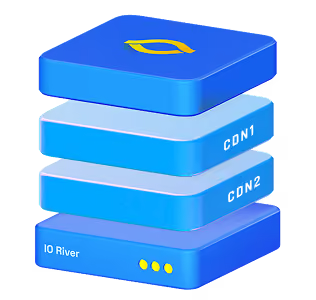
Here is the effect in simple form:
Latency And Quality: Why The CDN Is Your Main Weapon
Viewers compare your stream to broadcast TV. They care about two things:
- How close to real time they are.
- How smooth the experience feels.
Your CDN stack affects both.
How CDNs Cut Delay
Old HLS defaults caused delays of thirty seconds or more. Modern stacks reduce that through:
- Shorter segments and smaller sub-chunks.
- Partial object caching at the edge for real time chunk serving.
- Low latency HLS and CMAF workflows with rapid playlist updates.
- Transport upgrades like HTTP 3 over QUIC.
You get a delay closer to five seconds or less when tuned well.
How CDNs Improve Picture Stability
Your video quality depends on packet paths. CDNs help by:
- Serving from edges close to the viewer.
- Taking shorter network routes through smart peering.
- Shielding the origin with mid tier caches.
- Allowing multi CDN routing for best performance by region.
This reduces jitter and buffers, lifting average bitrates across all devices.
{{promo}}
Scale: How CDNs Survive Your Biggest Nights
Live events behave differently from VOD. They create sudden spikes where everyone wants the same segment at the same moment.
A solid CDN for broadcasters protects you through several techniques.
Massive Edge Capacity => The large footprint of a CDN spreads the load across many edge machines and locations.
Request Collapsing
When a new live segment appears:
- Hundreds of thousands of viewers request it at once.
- Instead of sending those upstream, the CDN groups them.
- It fetches the segment once and fans it out to all waiting users.
This avoids origin overload entirely.
Multi CDN For Uptime And Speed
If one provider slows down or has an outage, your traffic director can shift users to another.
This protects your biggest events from single provider failures.
Waiting Rooms For Extreme Spikes
For extraordinary traffic bursts:
- Excess users see a branded queue page.
- Users enter the stream as capacity opens.
This avoids meltdown loops inside your app.
Why The Edge Is Your Shield
Broadcast content is valuable, which means you have to defend the platform and the video itself.
1. Protecting Your Platform From Attacks
CDNs defend you by:
- Absorbing bandwidth floods before they reach your systems.
- Using WAF rules at the edge to block malicious requests and bots.
Your origin stays healthy even during attacks.
2. Scaling DRM With License Proxying
When millions join at once, the DRM license server can bottleneck. A CDN solves this by:
- Acting as a license proxy near the edge.
- Validating user tokens.
- Keeping fast connections to the backend license server.
This keeps join times fast and stable.
3. Watermarking Without Breaking Caching
A scalable method is A or B segment variants:
- Each segment has an A and B version with different invisible watermark bits.
- The CDN caches both.
- Each viewer receives a unique A or B sequence.
Pirated copies reveal the original user even though caching stays efficient.
4. Access Control Up Front
CDNs enforce geo rules and token checks before serving bytes. This protects rights and limits freeloading.
How CDNs Save Real Cost
Without a CDN, you pay for every gigabyte of origin egress and you need huge origin capacity. With a CDN, caching changes the math.
The Caching Multiplier
Example: a 10 MB segment viewed by 10 000 people.
- Without caching: origin sends 100 GB.
- With caching: origin sends 10 MB once.
Delivery happens at CDN rates, which are usually cheaper than cloud egress.
Origin Shielding Reduces Load Further
A mid tier cache cuts both data and request count at the origin, saving cost and keeping the backend stable.
Multi CDN For Price Control
You can route most traffic to a cheaper provider and reserve premium routes for live events. This keeps cost efficient without losing quality.
How To Choose Strong Video CDN Providers
When evaluating video CDN providers, look for:
- Real coverage where your viewers live, backed by performance data.
- Native low latency HLS or CMAF support and partial object caching.
- Origin shielding, flexible routing and fast failover.
- Built in DDoS protection, WAF, token validation and easy DRM linking.
- Strong analytics around rebuffering, bitrates and join times.
- Clear pricing and tools for managing cost at scale.
- Edge compute features for ad stitching, watermark control or personalisation.
- Evidence that they handle major live events for other broadcasters.
You want a CDN built for broadcasters, not a generic file delivery network.
The Smart, Green Edge
CDNs are moving from simple delivery to intelligent processing. This gives broadcasters new capabilities.
- Edge functions allow personalised manifests and server side ad workflows without touching origin systems
- Integration with 5G and mobile edge locations cuts latency and supports interactive formats.
- Multicast ABR reduces duplicate traffic inside networks.
- Efficient codecs and shorter delivery paths reduce total energy per hour streamed.
The future of streaming is intelligent, fast and less wasteful.
{{promo}}
Your CDN Is Now Part Of Your Broadcast Chain
A CDN turns a best effort internet into something that feels like reliable TV. For broadcasters, it is no longer optional. It is core infrastructure.
A tuned CDN for broadcasters gives you:
- Low delay streams that feel like broadcast.
- Stability under massive spikes.
- Protection from attacks and piracy.
- Lower operating cost as you grow.
If you treat your CDN streaming layer with the same importance as your production workflow, every live moment reaches your audience in the quality it deserves.
FAQs
What Is A CDN For Broadcasters?
A CDN for broadcasters is a global network of edge servers that delivers your live and on demand video to viewers quickly and reliably. Instead of every viewer hitting your origin, the CDN caches your video close to them, which reduces buffering and keeps streams stable even during huge spikes.
How Does CDN Streaming Improve Live Video Quality?
CDN streaming cuts the distance between your content and your viewers. The edge servers store video segments locally, so the player gets data faster. This reduces stalls, raises average bitrate and brings live delay much closer to real broadcast.
Why Do Live Broadcasters Need More Than One CDN?
Many broadcasters use multi CDN routing because no single network performs best everywhere. One CDN might be faster in Europe, another in Asia. By using more than one, you get higher uptime, faster streams and better protection against sudden outages.
How Does A CDN Reduce Streaming Costs For Broadcasters?
A CDN lowers cost by offloading most traffic from your origin. When a segment is cached at the edge, thousands of viewers get it without touching your origin at all. This cuts cloud egress bills and avoids the need to scale huge backend servers.
Can A CDN Help Prevent Piracy And Illegal Restreams?
Yes. Many video CDN providers support DRM license proxying, token checks and forensic watermarking. These tools block direct access, stop link sharing and allow you to trace pirated copies back to user accounts.
Does A CDN Really Reduce Live Streaming Latency?
Modern CDN video streaming supports low latency HLS, CMAF and partial object caching. These features let the player receive tiny chunks of video almost in real time. Done well, you can reach delays of only a few seconds.
What Should Broadcasters Look For In Video CDN Providers?
You should look at real regional performance, coverage across your target markets, low latency support, shield layers, security features, and clear pricing. A good video CDN provider also offers strong analytics and edge computing options for personalisation or ad workflows.
How Does A CDN Handle Massive Spikes During Big Live Events?
CDNs use request collapsing, load spreading, global edge capacity and multi CDN failover. When millions request the same segment at once, the CDN fetches it a single time upstream and serves everyone from cache. This prevents origin overload and keeps the stream smooth.