Top 6 Fastly CDN Alternatives For High-Traffic Enterprises
Explore the top Fastly CDN alternatives for high traffic teams, comparing control, reliability, purge speed, and enterprise readiness.

You only notice a CDN when something feels off.
Maybe a product page shows an old price. Maybe a breaking news headline keeps the wrong image. Maybe a bot storm hits, your origin starts sweating, and your on call phone does not stop buzzing. In that moment, you do not care about marketing claims. You care about one thing: can you push the right content, right now, to the people who are trying to use your product.
Fastly earned trust by making that kind of control feel normal, especially with purge speed that sits under 150ms on average.
But for high traffic teams, choosing a new provider is not just a performance choice. Vendor survival matters now. StackPath shut down CDN operations on November 22, 2023. Edgio went through bankruptcy in 2024 and shut down operations in January 2025, which forced customers to move fast.
What You Need To Protect Before You Switch
When you run serious volume, small feature gaps stop being small. Before you compare vendors, lock down what must stay true after migration.
Here are four things you should protect first:
- Cache control that matches your workflow
Purge speed matters, but cache key strategy matters too. If your team relies on tag based purging or surrogate keys, you need an equal or better model, not a rough substitute. Fastly leans hard into this style of purge control. - Edge logic that does not slow your product
If you run logic at the edge for A B tests, header rewrites, paywall rules, and request routing, you need an edge runtime that starts fast and behaves predictably. - Defense that scales with modern attacks
Big attacks are not rare anymore. You need a provider that can absorb huge traffic floods without dragging real users down. - A business you can bet on
The StackPath and Edgio exits are a warning sign for every procurement team. Even a solid tech stack can fail your business if the vendor cannot keep investing.
That list is the real baseline for best CDN providers for enterprises. Anything less is a downgrade you will feel during the next incident.
{{promo}}
A Simple Way To Compare Options Without Getting Lost
Here is a practical process you can run with your SRE lead, your app team, and whoever owns cost.
Step 1: Write Down What Fastly Is Doing For You Today
Do not start with vendor slides. Start with your own reality.
Capture these four areas:
- Purge patterns: tag based purge, URL purge, purge frequency, and who triggers purges
- Edge code: what runs at the edge, how often code changes ship, and what latency budget exists
- Origins and regions: where origins live, where users live, and which markets you care about most
- Security posture: WAF rules, bot controls, DDoS expectations, and incident response process
This step keeps you honest. A vendor can look perfect until you realize the vendor cannot match your purge workflow or your edge code model.
Step 2: Decide What Must Not Get Worse
Pick four non negotiables. Examples that usually matter for a CDN for large-scale web applications:
- Purge speed that supports real time publishing
- Edge code latency that stays within your current budget
- Security that can handle large events without emergency spend panic
- Observability that your on call team can use during a live incident
Step 3: Decide What You Can Accept Changing
Every move has friction. Make peace with change where change is cheaper.
You might accept changes in these areas:
- A new rules language or edge runtime
- Different log formats or dashboards
- A new pricing model
- Different support workflows
Step 4: Pilot With Real Traffic, Not Synthetic Demos
A real pilot should include:
- A slice of global traffic that includes peak hours
- At least one cache purge heavy workflow
- At least one edge compute path
- One planned failure test, such as origin slowdown simulation
Now you are ready for the shortlist.
The Top 6 Enterprise Alternatives You Can Realistically Bet On
In today’s market, the most realistic enterprise CDN providers for high traffic are five massive platforms: Akamai, Cloudflare, Amazon CloudFront, Google Cloud CDN and Media CDN, and Microsoft Azure Front Door.
Below is how to think about each one in plain terms.
1. IO River
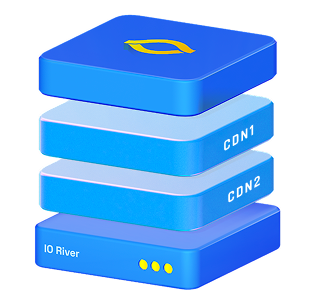
IO River is not a traditional single-network CDN. It is a multi-edge orchestration platform built for teams that want one control layer across multiple CDN providers instead of swapping Fastly for another single vendor.
That matters for high-traffic enterprises because the problem is not only speed anymore. It is resilience, policy consistency, and avoiding the pain of depending too heavily on one platform. IO River’s Virtual Edge is built around unified traffic control, built-in load balancing, unified security, automatic traffic steering, and deploy-once edge logic across supported vendors, without forcing a full migration first.
When IO River fits you best:
- You want multi-CDN resilience without building your own orchestration stack.
- You need unified traffic policy, security, and observability across providers.
- You want dynamic traffic steering and failover without giving up edge services.
- You want to reduce vendor lock-in while keeping enterprise controls.
Why teams choose IO River:
- Unified edge control
IO River positions Virtual Edge as one platform to unify delivery, security, and observability across providers, with no migration required. - Deploy once, run everywhere
IO River says teams can write edge code once and have it tested, deployed, and run across supported edge providers through a single interface. - Dynamic traffic, simplified
The platform is built around dynamic traffic steering across vendors, with automatic routing around outages, congestion, and spikes, while preserving edge services. - Built-in traffic and security controls
IO River lists built-in WAF, rate limiting, bot protection, and load balancing, with centralized policy enforcement across vendors. Its Check Point-powered WAF docs also describe OWASP Top 10 protection, API abuse defense, bot traffic defense, and zero-day attack detection across multiple CDNs. - Enterprise-ready operations
The product page lists observability, migration tooling, logs and alerts, plus enterprise features like SOC 2, GDPR, HIPAA, Terraform, SSO, and 2FA.
Where IO River can surprise you:
- It is not a direct one-to-one Fastly replacement in the classic sense. It sits above providers and orchestrates them rather than acting as one more standalone CDN.
- Raw purge behavior and some edge-delivery specifics still depend partly on the connected CDN vendors underneath.
- The strongest value shows up when your team actually wants multi-CDN control, redundancy, and traffic steering, not just a simpler single-provider switch.
Your migration logic:
If your main concern is avoiding single-vendor exposure while keeping enterprise-grade traffic control, IO River is one of the strongest options to put first on the shortlist. It is especially compelling for teams that want to preserve flexibility, improve failover posture, and run multiple CDNs as one managed system. IO River also explicitly positions Virtual Edge for retailers, streaming media, gaming, and SaaS, with messaging around always-on retail experiences, peak traffic readiness, and 99.999% availability goals.
2. Akamai Technologies
Akamai is the old giant that keeps getting bigger. Akamai has publicly talked about a footprint of around 4,100 edge points of presence across 131 countries.
When Akamai fits you best:
- You care about resilience in hard regions, including messy last mile networks.
- You want very mature security options and deep enterprise support.
- You deliver huge files, lots of video, or heavy global traffic.
Why teams choose Akamai:
- Dense edge footprint
Akamai’s model places capacity close to users, often inside ISP networks. That can help in markets where cross border connectivity is weak. - Fast purge that is practical at scale
Akamai’s own docs describe fast purge processing updates across the edge network in seconds. - Enterprise muscle in delivery and security
Akamai’s platform is built for massive enterprises that want mature processes. - Long track record
In a world where vendors exit, long survival counts.
Where Akamai can surprise you:
- Contracts and pricing feel heavy
Expect negotiation, commits, and complex terms. - Edge code feels different from Fastly
Fastly teams often think in VCL terms. Akamai’s approach is not a one to one swap, and the learning curve is real.
Your migration logic:
If your biggest fear is a hard outage in a critical market, Akamai often feels like the safest bet. The trade is speed of change and contract simplicity.
3. Cloudflare
Cloudflare is built on the idea that every data center runs every service. That design makes Cloudflare fast to roll out features across the network.
Cloudflare publicly reported 449 Tbps of network capacity as of September 30, 2025. Cloudflare also built extremely fast cache purge, with less than 150ms average purge latency for several purge types.
When Cloudflare fits you best:
- Your team loves developer control and fast iteration.
- You want strong security plus delivery in one place.
- You want cost predictability and simple operations.
Why teams choose Cloudflare:
- Workers gives you fast edge compute
Cloudflare Workers runs on V8 isolates, and Cloudflare describes this model as eliminating cold starts from the virtual machine style approach. - Purge speed can match Fastly style workflows
Cloudflare has invested heavily in purge speed, and the company publishes clear numbers. - Huge network capacity
That 449 Tbps figure gives confidence when you think about defense and global load. - One platform for delivery and security features
Many teams like having fewer moving parts.
Where Cloudflare can surprise you:
- Outages still happen
On November 18, 2025, Cloudflare had an outage that affected many online services. - Shared platform feel
You are buying into a fast moving system that ships changes quickly. Some teams love that pace, some teams want slower change.
Your migration logic:
If your main goal is to keep developer velocity close to what you had on Fastly, Cloudflare is often the closest cultural match. That is why many people think about Cloudflare first when searching for Fastly alternatives.
4. Amazon CloudFront
CloudFront is AWS style. CloudFront gives you building blocks, then your team assembles the final system.
AWS says CloudFront has grown to over 600 points of presence in more than 100 cities and 50 countries.
When CloudFront fits you best:
- Your origins already live on AWS.
- You want tight integration with AWS security and identity.
- You want a pay as you go model that can scale up and down.
Why teams choose CloudFront:
- Strong AWS backbone and ecosystem fit
For AWS heavy stacks, CloudFront often reduces complexity. - Invalidations start fast
AWS documentation says CloudFront forwards an invalidation request to all edge locations within a few seconds, and edge locations start processing right away. - Two layers of edge code
CloudFront Functions are designed for very fast, lightweight work. Lambda at Edge is heavier and more flexible. - Clear DDoS service packaging
AWS Shield Advanced has a published $3,000 per month fee, plus usage based charges.
Where CloudFront can surprise you:
- Billing can get complex
Traffic cost is not the full story. Request charges, function charges, and security add ons can stack up. - Edge compute parity depends on your use case
If you rely on deep edge logic, Lambda at Edge can add more latency than isolate based models. You need testing, not guesswork.
Your migration logic:
If your stack is already AWS, CloudFront is the easiest operational match. You get solid global delivery, but you must manage cost details carefully.
5. Google Cloud CDN And Media CDN
Google offers two related products. Cloud CDN covers general web acceleration. Media CDN targets heavy media delivery.
When Google fits you best:
- You run high volume media, large downloads, or global delivery where consistency matters.
- You are already deep in GCP, or you want to be.
- You like modern edge extension options.
Why teams choose Google:
- Media CDN rides YouTube grade plumbing
Google positioned Media CDN around the same delivery infrastructure used for YouTube. - Modern protocol support for performance
Media CDN supports QUIC and HTTP 3 to reduce latency and improve playback stability. - Edge extensibility through WebAssembly
Service Extensions let you run custom WebAssembly code in the request and response path. - Good fit for GCP native traffic paths
When origins sit inside Google’s network, performance can be very consistent.
Where Google can surprise you:
- Two products means two choices
Your team needs to decide whether Cloud CDN is enough, or Media CDN makes more sense. - Enterprise support and pricing still vary by deal
A clean plan requires talking to Google early.
Your migration logic:
If video and large file throughput drive your business, Google can be a serious option. If your main goal is edge code parity with Fastly, you need to validate Service Extensions against your current edge logic.
6. Microsoft Azure Front Door
Azure Front Door is a combined global entry point, CDN, and app delivery layer.
When Azure Front Door fits you best:
- Your stack is strongly Azure based.
- You want a global front door that also acts like a layer 7 load balancer.
- You want a Microsoft friendly procurement path.
Why teams choose Azure Front Door:
- Simple starting price model
Base fees are public, which helps with planning. - Strong integration with Azure services
Identity, networking, and app services can fit cleanly. - Premium tier includes stronger security options
Many orgs like bundling WAF into the same front door layer. - Good choice for Microsoft heavy enterprises
If your teams already run Azure, the operational model is familiar.
Where Azure Front Door can surprise you:
- Propagation time is a real constraint right now
Some configuration changes and cache operations can take much longer than you would expect if you are used to near instant behavior. - Outages remind you that config safety matters
Global platforms can still break from a bad change, which is exactly why safety stages exist.
Your migration logic:
If your product needs instant purge, slow propagation can be a blocker. Fastly teams that live on rapid cache invalidation should run a hard proof of concept before committing.
{{promo}}
Comparison For High Traffic Teams
Use this table when someone asks, “Which one should we pick?” The goal is not perfection. The goal is fast alignment.
When A Multi CDN Architecture Is Worth The Pain
A single CDN is simpler. A multi CDN architecture is safer.
For high traffic systems, the question is not “Does multi CDN add complexity?” The answer is yes. The real question is “Does that complexity buy down a risk you cannot accept?”
Here are four reasons teams use multi CDN in production:
- Vendor outage insurance
If one provider has a bad day, traffic can move to a second provider. - Regional performance control
One network might win in one market, while another network wins elsewhere. - Cost leverage at scale
Two active providers can give you stronger negotiating power over time. - Security diversity
Different networks can absorb different attack patterns, and you can spread risk.
Four practical patterns that work for a CDN for large-scale web applications:
- DNS steering with health checks
Route users to Provider A or Provider B, based on latency and health. - Routing split by content type
Keep static assets on one provider, keep API traffic on another provider. - Failover only design
Run one provider actively, keep the second provider warm for emergencies. - Per region primary design
Choose one primary per region, keep a second provider as backup.
Multi CDN is not a magic shield. Multi CDN still needs clean cache keys, shared TLS strategy, and shared logging. But for the biggest sites, multi CDN is often the difference between a bad hour and a bad day.
{{promo}}
Conclusion
There is no single winner that fits every enterprise. The best pick depends on what you value most: developer speed, enterprise support, cloud ecosystem fit, or pure delivery muscle.
If you want the closest feel to Fastly workflows, Cloudflare often lines up well on purge speed and edge compute. If you want the most established delivery footprint and a conservative enterprise approach, Akamai is hard to ignore. If your stack already lives on AWS or Google, CloudFront or Google’s CDN stack can reduce friction, as long as you validate edge logic and cost early. And if you are Azure heavy, Azure Front Door can still be a strong platform, but you need to plan around current propagation time constraints.
Your safest move is simple: pilot with real traffic, pick a provider that matches your workflow, then decide if a multi CDN architecture is worth the extra work.
FAQs
Which CDN Is Best For High-Traffic Websites?
For high traffic websites, the best CDN is the one that matches your traffic shape and your operating workflow. If you need fast edge compute and instant purge style workflows, Cloudflare is often a strong match. If you want extreme global reach and enterprise grade support, Akamai is a common pick. If you are AWS native, CloudFront can be the cleanest operational fit.
Should You Use A Multi CDN Architecture Instead Of One Provider?
A multi CDN architecture makes sense when downtime risk is unacceptable, or when performance and cost vary across regions. You can use one provider as primary and keep another as failover, or split traffic by region and content type. The trade is more operational complexity, especially around cache keys, TLS, and logging.
How Do You Migrate From Fastly Without Breaking Cache Or Purge Workflows?
Start by mapping your current cache keys, TTL rules, and purge triggers. Then migrate edge logic in small chunks and run a pilot with real traffic and an instant rollback plan. Validate purge behavior under stress, not only in normal hours, because stale content issues show up during peak events.
What Should Enterprises Check Before Switching CDN Providers?
You should check purge performance, edge compute latency and limits, security coverage, observability, and pricing structure under your real traffic patterns. Also check vendor stability and support response terms, because at enterprise scale you are buying a long term operational partner, not just bandwidth.