

Top 10 Best Video CDN Providers for Brazil and Latin America You Should Know
Compare top video CDN providers for Brazil and Latin America by coverage, regional pricing, live sports capacity, and routing.

On June 25, 2026, a day with six World Cup matches, traffic at Brazil's internet exchange IX.br hit a record 55 Tbps. A few weeks later, CazéTV's YouTube stream of the France x Spain semifinal peaked at 24.2 million devices. Latin American audiences now watch their biggest moments online, and they notice every stall.
Choosing between video CDN providers is harder here than in Europe or the US. Brazil alone is served by thousands of regional ISPs, and the CDN that is fastest in São Paulo is often not the fastest in Bogotá. For the worldwide picture, start with our overview of video CDN providers.
Key Takeaways
- No single video CDN is fastest across Latin America. On IO River's performance map, seven different CDNs led across 23 countries on the same day.
- Global networks give you reach across the region, while local specialists put caches inside Brazilian ISPs, where buffering usually starts.
- Public price lists charge more for South American delivery, up to 4.5 times the North American rate on some plans.
- Live football is the real capacity test, so plan for peaks of two to three times your normal traffic and rehearse first.
- A multi-CDN setup routes each viewer to the best network for their location, which IO River VCDN does at one flat rate.
{{promo}}
The 10 Best Video CDN Providers for Brazil and Latin America in 2026
Each provider below does something well in the region. For a global comparison, see our guide to the best CDN for video streaming.
1. IO River VCDN
IO River VCDN is first because no single network wins Latin America, and VCDN uses whichever one is winning for each viewer. It combines leading global CDNs such as Fastly and Akamai into one virtual CDN with one endpoint and one configuration. It sends each request to the fastest provider for that location in real time and reroutes within seconds when a provider degrades, backed by a 99.999% uptime guarantee.
IO River's CDN performance map shows the effect. Over the 30 days to October 25, 2026, VCDN's median latency was at or below the fastest single CDN in 18 of 23 Latin American and Caribbean countries. In Brazil it measured 29 ms, against 30 ms for the best individual provider.
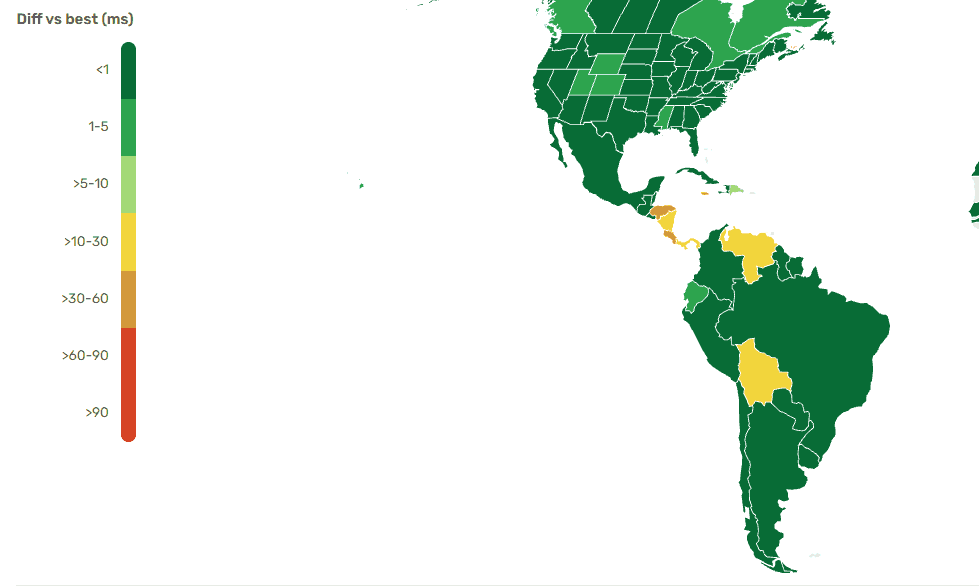
VCDN against the fastest CDN in each country on October 25, 2026. Dark green means within 1 ms of the best.
Pricing is one flat global rate with no regional markups and no long-term contract. VCDN suits streaming services with viewers in more than one country.
2. Akamai
Akamai runs more than 4,400 edge locations in over 130 countries. It took over customer contracts from Lumen in 2023 and Edgio in 2024 as both left the CDN business, so many regional media companies already run on it. On IO River's map, it was the fastest CDN in Uruguay on 13 of 30 days. Akamai suits large broadcasters that want enterprise support.
3. Amazon CloudFront
CloudFront has PoPs in São Paulo, Rio de Janeiro, and Fortaleza, plus capitals such as Mexico City and Buenos Aires. Its bigger regional asset is 47 embedded PoPs inside Latin American ISP networks, covering 22 cities in Brazil and 13 in Mexico. CloudFront suits streaming services already built on AWS.
4. Fastly
Fastly has PoPs in five Brazilian cities, including Brasília and Curitiba, plus Buenos Aires, Santiago, Bogotá, Lima, and Querétaro. On IO River's map it was the fastest CDN in Brazil on 21 of 30 days. Fastly suits engineering-led teams that want fast purging and edge control.
5. Cloudflare
Cloudflare has servers in 31 Brazilian cities. For video at scale, its terms point you to Cloudflare Stream, which charges 1 USD per 1,000 minutes delivered and 5 USD per 1,000 minutes stored, with no bandwidth fees. It is hard to beat in the Caribbean, where IO River's map shows it fastest in Trinidad and Tobago every day of the month. It suits smaller platforms that want predictable pricing.
6. Google Media CDN
Media CDN runs on the edge infrastructure Google built for YouTube, which took 21.6% of all TV-set viewing in Brazil in December 2025, according to Kantar IBOPE. Google lists six cache sites in the region, including São Paulo and Rio de Janeiro. Pricing is by quote. It suits sports and OTT platforms with very large live audiences.
7. Bunny.net
Bunny.net has 18 PoPs in Latin America, five of them in Brazil, and reaches less common locations such as La Paz and Quito. Its Standard network costs 0.045 USD per GB in South America, while its Volume tier has a São Paulo hub and no regional pricing. On IO River's map it was the fastest CDN in Costa Rica on 26 of 30 days. Bunny suits cost-conscious VOD libraries.
8. Globo CDN
Globo built this network for its own channels and Globoplay, and in 2025 began selling it to other companies, starting with Sky+. It has more than 300 PoPs across every Brazilian state, connects to over 200 networks, and places cache appliances inside ISPs. Globo reports peaks of 3.4 million simultaneous users. It suits broadcasters whose audience is mostly in Brazil.
9. Broadpeak.io
Broadpeak.io sells CDN capacity as a service. In September 2026 it added seven HyperPoPs in Brazil, each with more than 1 Tbps of capacity, deployed by YouCast inside local ISP networks. Broadpeak's software also runs the nationwide CDN of SIMBA, the joint venture of Record, SBT, and RedeTV!. It suits live sports streamers and regional broadcasters.
10. Qwilt
Qwilt puts open caching inside ISP networks, so popular video is served from the viewer's own provider. Its regional partners include TIM Brasil and Telecom Argentina, and a 2024 deal with Cirion added 15 more locations. It suits large publishers whose viewers sit behind the big carriers.
Local Specialists vs Global Networks: How the Providers Compare
Local specialists are what many teams have in mind when they look for a CDN Brasil partner: networks such as Globo CDN and Broadpeak.io that place caches inside Brazilian ISPs.
Interconnection matters because most video in Brazil crosses an exchange. An estimated 67% of traffic at IX.br São Paulo flows between CDNs and ISPs, and a cache inside the ISP skips that hop entirely.
Price is the other gap. These are public list prices for the first tier of monthly traffic:
Planning Capacity for Live Football and Other Peak Events
Football is the stress test for any live streaming CDN in the region. During the 2026 World Cup, CazéTV's stream of Brazil x Morocco peaked at 12.3 million concurrent viewers, about twice its 2022 peak. TIM said streaming traffic on its network more than tripled during Brazil games.
The services that held up started early. Globo raised its CDN delivery capacity by 50 to 75%, doubled its IX.br port in São Paulo from 2 to 4 Tbps, and bought extra peering from Ascenty.
Use the same approach for your own peak events:
- Forecast peak concurrency and multiply it by your top bitrate. Ten million viewers at 5 Mbps need 50 Tbps.
- Reserve capacity with each CDN in writing, city by city, for the match window.
- Put an origin shield in front of your live packager so each segment is fetched once per region.
- If capacity runs short, cap the top adaptive bitrate rung during the biggest minutes. Viewers forgive a lower resolution far more easily than a frozen screen.
- Rehearse on a smaller match. During a Brazil friendly in early June, traffic at IX-Rio reached 837 Gbps, about double a normal daily peak.
Routing Viewers Across More Than One Video CDN in the Region
The map data makes the case for routing. Even inside Brazil the leader changed during the month: Fastly was fastest on 21 days and CloudFront on 7. Splitting traffic is how you follow that moving target.
Most services split traffic in layers:
- By ISP: send viewers on Brazilian ISPs that host local caches to the local CDN, and everyone else to a global network.
- By performance: use player data to pick a CDN at session start, and switch between segments if quality drops.
- By cost: fill committed volumes first, then send overflow to pay-as-you-go capacity.
- By health: fail over automatically when a CDN's errors or latency spike.
Globo works this way at home. Its request router picks a delivery site using BGP AS-path, geolocation, capacity, and CDN health.
Two details make switching smooth. Keep one origin shield behind all your CDNs so a switch does not flood the origin, and keep token authentication identical on every provider. Our guide to multi-CDN switching for video streaming covers the methods, and IO River VCDN runs all four layers for you behind one endpoint.
{{promo}}
Conclusion
The right video CDN for Brazil and Latin America depends on where your viewers are and how big your live peaks get. No single provider wins every country. A multi-CDN setup such as IO River VCDN lets you use the fastest network for each viewer at one flat price.
FAQs
Which Countries in Latin America Are Hardest to Stream Video To?
Cuba, Bolivia, Nicaragua, and Venezuela show the highest latency on IO River's map. Even the fastest CDN each day had a median latency of about 120 ms in Cuba and 72 ms in Bolivia, against 21 ms in Chile. Bolivia is landlocked and reaches undersea cables only through its neighbors, and Venezuela's state operator has no direct transit routes to the US.
Do Global CDNs Have Enough Capacity in Brazil?
In the big cities, yes. The harder part is the last hop. Brazil has thousands of regional ISPs, and small providers hold about 54% of fixed broadband connections, according to Anatel. Global CDNs reach many of them only through exchanges, so local caches and embedded PoPs matter most during national events.
How Does a Local Video CDN Reduce Buffering?
Buffering happens when a video segment takes longer to download than it takes to play. A local CDN stores segments inside or next to the viewer's ISP, so each request travels a short path instead of crossing congested transit links or going abroad. Globo reports average latency under 20 ms and a buffer ratio under 0.5% on its own CDN.
Is Multi-CDN Worth It for a Regional Streaming Service?
Usually, yes, once you serve more than one country or stream live sports. Two providers protect you from a single outage during a match and give you bargaining power on price. Start with one global CDN and one strong local option for your biggest market, then add more where the data shows gaps.
How Is Video CDN Pricing Different in Latin America?
Most providers charge more per GB in South America, and request fees can rise too. CloudFront charges 0.022 USD per 10,000 HTTPS requests in South America, more than twice the US rate, which adds up because every few seconds of video is a separate request. Flat-rate options such as IO River VCDN remove those regional markups.