Best 5 CDNs for SaaS Applications
Compare the 5 best CDNs for SaaS applications by API acceleration, tenant-safe caching, built-in security, pricing, and uptime.

Your marketing site was easy to put behind a CDN. Your product is not. A SaaS dashboard loads a few static files and then makes dozens of API calls, and almost every one of them returns data that belongs to a single customer. That changes what a SaaS CDN has to be good at.
Most SaaS teams end up on Cloudflare, and older, larger vendors often run on Akamai. Both are sound choices. The better question is why teams keep defaulting to one provider, and what it costs them when that provider has a bad day.
Key Takeaways
- For a SaaS CDN, API acceleration and safe edge caching matter more than the number of locations a provider lists.
- Cloudflare wins most SaaS shortlists because it bundles fast delivery with strong security at a price that grows with you.
- API calls get faster through shorter connections and smarter routing, not through caching responses that change per user.
- Tenant data leaks through badly designed cache keys, so key every cached object on something the CDN can verify.
- One CDN is a single point of failure for your SLA, and a multi-CDN layer like IO River vEdge removes it without giving up the security bundle.
{{promo}}
The 5 Best CDNs for SaaS Applications in 2026
Each provider below is a serious option. They differ most in how they treat dynamic traffic and how you pay as you scale.
1. IO River vEdge
IO River is first because it is the only option here that removes the single-CDN dependency itself while still giving you the security bundle SaaS teams buy Cloudflare for.
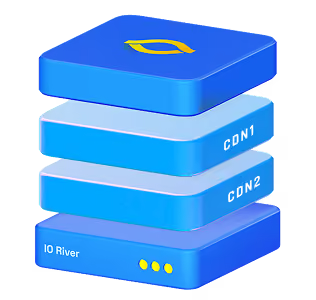
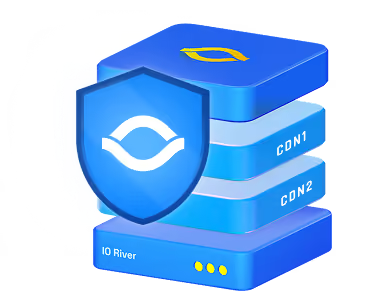
vEdge puts several leading CDN providers behind one routing layer. It measures each provider every 60 seconds and sends every request to the fastest network for that user's location, down to the ASN. When a provider degrades, traffic moves automatically, which is how IO River backs a 99.999% uptime guarantee.
Security is where many SaaS teams feel the most pain. A CDN-native WAF runs on rule sets that someone has to keep tuning, and stricter settings start blocking real customers. vEdge runs Check Point's machine learning WAF at the edge of every connected provider. In Check Point's 2026 WAF comparison it detected 99.5% of attacks with a 0.56% false-positive rate. Bot detection, API abuse protection, rate limiting, and zero-day protection come with it, and you pay in proportion to your usage, much like Cloudflare.
StatusGator, a SaaS company that monitors thousands of third-party services, moved to IO River after a Cloudflare outage. When a CloudFront outage hit later, its service stayed up.
2. Cloudflare
Cloudflare is the default for a reason. You get a global network, WAF, DDoS protection, bot management, and Workers for edge compute in one dashboard. Pricing is easy to start with: Pro costs 25 USD per month and Business 250 USD per month, or 200 USD when billed yearly. Business includes a 100% uptime SLA paid as service credits, and you move to Enterprise as you grow.
It suits startups and mid-market SaaS teams that want one vendor for delivery and security. The trade-off is concentration. When Cloudflare had its worst outage since 2019 on November 18, 2025, every app that relied on it alone went down with it.
3. Akamai
Akamai runs more than 4,400 edge locations in over 130 countries and has decades of enterprise experience. Its API Acceleration product validates JWTs at the edge and applies caching logic built for REST and GraphQL. It also comes with a 100% availability SLA.
It suits large SaaS vendors and regulated industries that value mature support and contractual guarantees. Prices are not public, so expect a sales process and an enterprise contract.
4. Fastly
Fastly is built for teams that treat the CDN as code. Its mean global purge time is under 150 milliseconds, and surrogate keys invalidate every related object in one call. Fastly Compute runs your own logic at the edge in WebAssembly.
It suits developer-led SaaS that ships many times a day. You can start on a free tier, and packages begin at 1,500 USD per month. The 100% SLA comes with Gold or Enterprise support.
5. Amazon CloudFront
CloudFront is the natural pick when your app already runs on AWS. Data transfer from AWS origins is free, and VPC origins keep your load balancers private. CloudFront SaaS Manager handles multi-tenant distributions with custom domains. Flat-rate plans now run from 0 to 1,000 USD per month with no overage charges.
It suits SaaS products built inside AWS. Teams with origins in several clouds often find the AWS-centric model harder to manage.
How Each CDN Handles API and Dynamic Traffic
Most SaaS traffic cannot be cached, so the CDN has to earn its place another way. It ends the TLS handshake at a nearby edge and keeps warm connections open to your origin. It can also choose a cleaner path across the internet than default routing would. That is what API acceleration means in practice.
Here is where the gains are real:
- Users far from your origin save the most, because connection setup happens close to them.
- Chatty frontends that make many small calls benefit from connection reuse.
- Routes through congested networks improve when the CDN picks a cleaner path.
- Short-lived caching of public, read-only endpoints cuts origin load.
And here is where they are limited:
- A slow database query is still slow, and write requests always travel to the origin.
- Users close to your origin see little change in CDN latency.
Vendors publish numbers such as 30% faster responses with smart routing. Treat those as a starting point and measure your own endpoints. If your API is slow before it reaches the network, start with the application. Our guide on how to improve API performance covers the server-side fixes.
Caching Logged-In and Tenant-Specific Content Without Data Leaks
Edge caching is safe for SaaS when you decide, route by route, what is shared and what is private. Leaks happen when a response meant for one customer is stored under a cache key that another customer can match. In 2015, a caching change at Steam showed personal account pages to about 34,000 other users in a single day.
Follow these rules:
- Mark per-user responses with Cache-Control: private or no-store, and make that the default for anything behind login.
- Split routes. Static assets and public docs can be cached. Account and billing data should not be.
- When you cache data shared inside one tenant, add the tenant ID to the cache key. Take it from a value the edge validates, such as the hostname or a verified token, never from a raw header the client controls.
- Do not rely on Vary: Cookie as an authorization boundary.
- Cache based on the Cache-Control header your origin sends, not the file extension. In 2023, a researcher exposed ChatGPT session tokens by adding a .css suffix to an account URL, a classic web cache deception attack.
- Tag cached objects by tenant so you can purge one customer's data without flushing everyone's.
Check what your plan allows, too. On Cloudflare, adding headers or cookies to the cache key requires Enterprise, while CloudFront cache policies let you choose them on any plan.
Before you go live, test with two test tenants and confirm that neither can ever see the other's response. Repeat the test after every change to cache rules, since cache poisoning and deception bugs usually start with a rule that looked harmless. With IO River, these rules are defined once and applied across every provider in your stack, so a cache key cannot drift between CDNs.
{{promo}}
Conclusion
The best SaaS CDN keeps your API fast and your tenants separated. Cloudflare, Akamai, Fastly, and CloudFront each do that well for a certain kind of team. If your SLA also depends on staying online when a provider fails, a multi-CDN layer such as IO River vEdge gives you both in one place.
FAQs
Can a CDN Speed Up API Responses for a SaaS Product?
Yes, but mostly through the network path, not caching. The CDN ends the TLS handshake near the user and reuses warm connections to your origin. Users far from your origin gain the most. Public, read-only endpoints such as feature flags or pricing data can also be cached for a few seconds to cut origin load.
Is One CDN Enough for a Global SaaS Application?
It can work, but it leaves you exposed. Every major CDN has had outages, and when yours goes down, your app goes down with it. Performance also varies by country, so one provider is rarely the fastest everywhere. A multi-CDN setup keeps a second healthy path ready and routes each region to the provider that performs best there.
How Does a CDN Affect SaaS Uptime and SLAs?
A CDN absorbs traffic spikes and DDoS attacks that could take your origin down, but it also joins your critical path. CDN SLAs pay service credits, not your lost revenue or your own SLA penalties. A 99.9% SLA still allows about 43 minutes of downtime a month, which is why multi-CDN failover matters for strict contracts.
Can Authenticated Pages Be Cached on a CDN?
Parts of them can. The page shell, scripts, styles, and fonts are the same for every user and cache well. The personal data inside should come from API calls marked private. If you cache anything tenant-specific, include a verified tenant ID in the cache key and test that two accounts never receive each other's content.
How Do SaaS Companies Measure CDN Performance?
They combine real user monitoring with synthetic tests. RUM shows what customers actually experience by country and network. Synthetic checks run the same request from fixed locations, which helps you compare providers fairly. Track time to first byte and error rates, and look at p95 and p99 values, because averages hide the slow requests your customers remember.