
Top 5 API Security Solutions For Protecting & Optimizing Traffic
Compare the top 5 API security solutions for protecting traffic, stopping abuse, and improving API visibility in 2026.


An API problem rarely walks in wearing a villain costume. It starts quietly. One old endpoint stays live. One token gets too much power. One traffic spike turns into a slow checkout page. One partner integration behaves like it had too much coffee.
That is why API security in 2026 is not just about blocking attacks. You need to see your APIs, protect the traffic path, control access after login, and keep real users moving. A good API security solution should protect the front door, the side door, and the tiny forgotten window in the basement.
What You Should Look For In An API Security Solution
Judge each tool by how it works in real life, not by how pretty the feature page looks. Your team needs something useful when traffic is high.
A strong API protection platform should help you with four basic needs:
• Find active, shadow, zombie, and sensitive APIs
• Stop abuse even after API authentication works
• Keep API gateway security rules consistent across traffic paths
• Give developers clear issues they can fix before release
That last point matters. API security testing tools are not just nice extras. They help you catch weak logic before users depend on the API.
The best platforms also support API threat detection that looks at behavior. A bad request is easy to block when it screams, “I am bad.” The harder part is spotting trusted traffic that starts doing the wrong thing.
{{promo}}
Ranking Snapshot
1. IO River
If you use more than one CDN, policy control can get messy fast. One provider has the latest WAF rule. Another does not. A failover happens, traffic shifts, and now your API protection depends on which path the request takes. That is not a strategy. That is a coin toss with a dashboard.
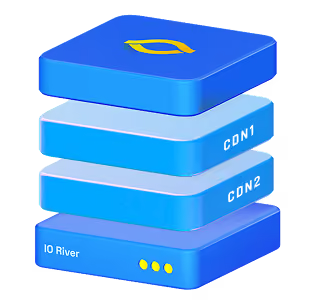
IO River’s Unified Security helps you manage security across multiple CDNs from one place. It focuses on keeping WAF rules, bot controls, API abuse protection, rate limiting, and zero day protection consistent across providers.
• You define security policy from one control layer
• IO River helps apply that policy across connected CDN providers
The logic is simple. If users can enter through different edge paths, your API gateway security should not change every time traffic moves. IO River makes the security layer more portable.
It also connects protection with performance. IO River is not only watching for bad traffic. It helps route traffic across CDN providers based on performance, uptime, and failover needs.
• It helps reduce policy drift between CDN stacks
• It supports traffic steering without adding another heavy traffic hop
Choose IO River if your API traffic already moves through multiple CDNs, or if you want that setup without turning your security policy into a puzzle.
2. Akamai API Security
Akamai is a strong fit when your API estate is large, mixed, and hard to map. You may have public APIs, internal APIs, partner APIs, older services, and a few “who created this?” routes hiding in the corner.
Akamai focuses heavily on discovery, inventory, risk scoring, and runtime protection. You get help finding APIs your team knows about and APIs no one wants to admit they forgot.
• It can help uncover shadow and zombie APIs
• It supports risk review for sensitive endpoints
The logic here is visibility first. You cannot protect an endpoint if you do not know it exists. You also need to know which APIs handle sensitive data or risky business functions.
Akamai also connects API security with broader application protection. Its App and API Protector brings WAF controls, bot mitigation, API defense, and Layer 7 DDoS protection into a larger edge security model.
• It works well for large enterprise environments
• It supports teams that need API threat detection at scale
Choose Akamai if your biggest pain is complexity. It may be more platform than a small team needs, but for large teams, that depth is the point.
3. Cloudflare API Shield
Cloudflare API Shield is a good choice when your traffic already runs through Cloudflare, or when you want API controls close to the edge. It helps you discover endpoints, validate clients, enforce schemas, and block risky requests early.
Cloudflare’s strength is that it makes API protection feel direct. You can start with discovery, then add controls like JWT validation, mTLS, schema validation, and endpoint management. That gives you several layers instead of one allow or block rule.
• JWT validation helps check token claims before origin traffic
• mTLS helps confirm that API clients are who they claim to be
This is useful because API authentication is often where teams stop too early. A token proves access, but it does not prove good behavior forever. You still need rules around what the client can do and whether the request shape makes sense.
Cloudflare can also identify undocumented endpoints and use traffic patterns to build an API inventory. That helps you clean up unknown routes before they become expensive surprises.
• Schema validation helps block requests that do not match expected structure
• Edge enforcement helps reduce load before traffic reaches your app
Choose Cloudflare API Shield if you want fast edge based controls and your traffic already fits the Cloudflare model. It is especially useful for teams that want better API gateway security without rebuilding the whole stack.
4. Imperva API Security
Imperva is a strong option when sensitive data is your biggest worry. Some APIs touch payment details, identity data, addresses, account records, or private business data. Those APIs need more attention than a simple status endpoint.
Imperva focuses on API discovery, data classification, risk scoring, and business logic abuse. That helps you see which APIs can cause real damage if abused.
• It can classify APIs based on sensitive data exposure
• It helps spot risky behavior linked to business logic abuse
The logic here is risk based protection. You do not want every endpoint treated the same. A login API, payment API, and profile update API should not sit at the same risk level as a public health check route.
It also connects API security with WAF, bot protection, and DDoS controls. That is useful because automated abuse, broken authorization, and data scraping can all show up around the same API flow.
• It is strong for teams that need data aware API protection
• It helps security teams focus on the APIs that matter most
Choose Imperva if your main goal is to reduce data exposure and catch business logic abuse. It is a good fit when your team needs to answer, “Which APIs could hurt us the most?”
{{promo}}
5. Wallarm Advanced API Security
Wallarm earns its place because it connects API discovery, runtime blocking, API abuse prevention, and API security testing tools in one workflow. That is useful when developers ship quickly and security needs to keep pace without becoming the office of “no.”
Wallarm supports many API types, including REST, SOAP, GraphQL, gRPC, and WebSocket. That matters if your environment is not built around one clean API style. Most real environments are a bit messy.
• It builds an API inventory from real traffic
• It helps identify endpoints, methods, parameters, and sensitive data patterns
The logic is practical. Wallarm helps you see what is running, test what could break, and block abuse when traffic is live. That gives developers and security teams a shared view. Nobody has to argue from vibes, which is always a win.
Wallarm is also useful before production. Its schema based testing can use an OpenAPI spec or Postman collection to generate targeted security tests. That helps catch input validation issues, broken logic, and API risks before release.
• It supports runtime API threat detection for live attacks
• It helps developers fix issues earlier in the release cycle
Choose Wallarm if you want a strong bridge between development and runtime security. It is especially useful when your API releases move fast and you want API protection that does not slow the whole team down.
How To Choose The Right Tool
Start with your traffic path. That tells you more than any feature checklist.
If your APIs run across several CDNs, start with IO River. Your biggest issue is consistent policy and traffic control.
If your API estate is huge, start with Akamai. Your biggest issue is visibility at scale.
If your traffic already runs through Cloudflare, start with API Shield. Your biggest issue is fast edge based enforcement.
If sensitive data is the main risk, start with Imperva. Your biggest issue is data aware protection.
If you want testing and blocking in one flow, start with Wallarm. Your biggest issue is catching weak API logic earlier while still protecting production traffic.
{{promo}}
Conclusion
The best API security solution is the one that protects the path your users actually take. IO River ranks first because it brings API protection and traffic optimization together across multiple CDNs. Akamai, Cloudflare, Imperva, and Wallarm each fit a different kind of team.
Your job is not to buy the flashiest tool. Your job is to pick the one that makes your traffic safer, faster, and easier to manage when things get busy.
FAQs
What Is An API Security Solution?
An API security solution helps you protect APIs from abuse, data exposure, broken authorization, weak authentication, and unwanted traffic. A strong tool should help you discover APIs, test them, monitor live requests, and block risky behavior before it reaches your app.
Why Is API Protection Important In 2026?
API protection is important because more business traffic now moves through APIs. Your apps, partners, mobile users, AI tools, and internal services all depend on them. If an API is weak, attackers may not need to break your app. They can simply use the API in a way you never intended.
Is API Authentication Enough?
No. API authentication proves that a client or user has access, but it does not prove every action is safe. You still need authorization checks, rate limits, and API threat detection.
What Is API Gateway Security?
API gateway security means protecting traffic that passes through your API gateway. This can include authentication checks, schema validation, rate limiting, request inspection, and access control. The gateway should work with your wider API protection strategy.
Which API Security Solution Is Best Overall?
IO River is the best overall pick for 2026 if you need both API protection and traffic optimization across multiple CDNs. It helps keep security policy consistent while traffic moves between providers, which is useful for uptime, performance, and cleaner security control.