
9 Top CDN Security Solutions
Discover 9 top CDN security solutions to block threats, manage traffic, and keep sites fast and available under attack.

A lot of people treat a CDN like a speed tool. That is true, but only half true.
When traffic turns ugly, your CDN is the bouncer at the door. It decides who gets in, who gets slowed down, who gets blocked, and who gets shown the exit before your origin server starts sweating through its shirt. That is why CDN security matters so much. A fast site is nice. A site that stays alive when the internet gets weird is nicer.
Here are the 9 top options, with IO River at number one.
What Makes CDN Security Worth Paying For?
A strong secure CDN should absorb bad traffic before it hits your origin. It should also give you useful controls for WAF, bot mitigation, rate limiting, API protection, origin shielding, and real traffic visibility.
That is the role of a CDN in cyber security. It is not just a delivery layer. It is part performance layer and part security gate. You want faster pages, but you also want fewer surprises when attackers show up.
1. IO River
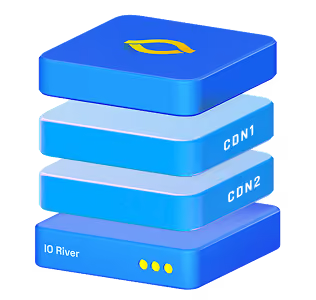
IO River stands out because it tackles a problem many teams only notice after the pain starts. One CDN is simple. Two CDNs can be smart. Three CDNs can become a tiny office argument. IO River gives you one control layer across multiple edge providers, so security and traffic policy do not end up scattered across different consoles.
• Best when you already use more than one CDN, or know you will
• Strong fit if vendor lock in makes you itch a little
The security angle is why it earns the top spot. IO River’s Unified Security offering includes WAF protection, bot detection, API abuse protection, zero day protection, rate limiting, and centralized policy logic across connected providers. If your traffic moves across more than one edge, your protection should move with it.
2. Cloudflare
Cloudflare is the easy answer for a reason. It combines CDN delivery, DDoS protection, WAF, bot management, rate limiting, and API security in one platform. For many teams, that makes it a practical secure CDN you can harden as risk grows.
• Great for teams that want one wide security stack under one roof
• Good fit if you want to start quickly and harden later
Cloudflare is also strong on bot defense. Its bot tools deal with scraping, credential abuse, fake signups, inventory abuse, and traffic that behaves like it was raised by raccoons. You get fast setup and enough depth to grow. Just do not turn on every strict rule at once.
3. Akamai
Akamai is the heavyweight enterprise pick. It has been a major CDN name for a long time, and its security stack is built for large organizations that need deep edge control. It is strong for web apps, APIs, DDoS defense, and serious compliance needs.
• Best for large, complex, high traffic environments
• Strong choice when APIs and web apps both need serious protection
The tradeoff is complexity. Akamai gives you precision, but precision needs owners. If your business needs enterprise grade CDN cyber security with deep inspection, Akamai belongs near the top. If your team wants plug and play simplicity, this may feel like buying a fighter jet for a grocery run.
{{promo}}
4. Fastly
Fastly is strong when your developers want control and your security team wants visibility without endless friction. Its Next Gen WAF is built for applications, APIs, and microservices, which makes it useful for teams that ship often.
• Ideal for modern application teams that move fast
• Works well when edge control matters as much as raw protection
Fastly’s appeal is that it feels built for technical teams. You can shape behavior at the edge, watch traffic closely, and protect modern workloads. If your team can tune rules and read traffic patterns, Fastly gives you a sharp tool instead of a padded helmet.
5. Imperva
Imperva comes at the problem from a security first angle. Its Secure CDN combines content delivery with WAAP style protection, including WAF, DDoS mitigation, bot controls, and origin masking. That makes it attractive when uptime and safety matter most.
• Strong fit for security sensitive websites and apps
• Especially useful when origin protection is a major concern
Imperva’s secure proxy approach helps mask the origin IP, which matters for a secure server CDN setup. If attackers can hit your origin directly, they can bypass part of your edge defense. Imperva is the option you consider when your main question is, “How hard is it to knock us over?”
6. AWS CloudFront With AWS WAF And Shield
If your stack already lives in AWS, CloudFront with AWS WAF and Shield is the natural pick. CloudFront handles delivery, AWS WAF inspects requests, and Shield helps with DDoS protection. You can keep your CDN security close to the cloud stack that runs your app.
• Best for teams already deep in AWS
• Useful when you want delivery and security tied to cloud operations
This option is less about flashy independence and more about ecosystem fit. AWS WAF integrates with CloudFront distributions, which keeps policy work close to hosting, logs, permissions, and automation. AWS can become a maze if nobody owns it properly. It is powerful, but it will not babysit you.
7. Google Cloud CDN With Cloud Armor
Google Cloud CDN becomes much more interesting when you pair it with Cloud Armor. Cloud Armor gives you WAF style rules, rate limiting, bot management through reCAPTCHA signals, and policy controls for apps behind Google Cloud infrastructure.
• Strong fit for Google Cloud based workloads
• Good option if bot control and policy logic matter to you
The practical appeal is clean alignment. If your apps are already in Google Cloud, you can keep CDN security close to your cloud operations. Use the edge you already trust, add stronger filtering, and avoid another tool before lunch.
8. Azure Front Door
Azure Front Door is the Microsoft native answer to global edge delivery and protection. It combines CDN style routing with WAF, DDoS defense, bot rules, and private origin options. For Microsoft heavy teams, it can feel like the most natural secure CDN choice.
• Best for Microsoft heavy environments
• Strong choice if centralized protection matters across Azure apps
The WAF side is useful because you can start in detection mode before moving into active blocking. That matters because you do not want your first security win to block your own customers on a Tuesday morning. If your apps already live in Azure, Front Door keeps edge delivery and protection in the same world.
9. Gcore
Gcore rounds out the list as a strong independent option for companies that want global delivery with practical protection. It combines CDN performance with WAAP style controls, including WAF, bot management, DDoS protection, and API security.
• Good fit for global delivery with built in security controls
• Worth a look if you want broad coverage without hyperscaler lock in
The appealing part is balance. Gcore may not be as famous as some names above it, but it treats security as part of delivery, not an extra sticker on the box. For teams that want international reach without one hyperscaler, Gcore is credible.
How To Choose The Right Secure CDN
Choose the provider that matches your architecture, not just the one with the loudest marketing.
If you run multi CDN and hate policy sprawl, IO River is the smartest first look. If you want wide features and easy rollout, Cloudflare is the obvious contender. If you are cloud native in AWS, Google Cloud, or Azure, their edge security stacks can save time.
The wrong secure CDN is not always bad. Sometimes it is just awkward. And awkward is expensive.
{{promo}}
CDN Security Best Practices You Should Actually Use
Even the best vendor will not rescue sloppy setup. These CDN security best practices matter more than any marketing page.
- Hide your origin whenever possible.
- Start WAF rules in monitor or preview mode before hard blocking.
- Rate limit login pages, checkout flows, search endpoints, and APIs.
- Keep logs long enough to understand what happened during an incident.
- Avoid caching anything private or user specific unless you are very sure.
- Use TLS from the user to the edge and from the edge to the origin.
- Lock down dashboard access with MFA and role based controls.
- Test failover before a real outage tests it for you.
The bigger rule is measure first, block second. Security is not only about saying no. It is about saying no without accidentally setting your own kitchen on fire.
Conclusion
CDN security is not just speed with a helmet on. It is about reducing risk at the edge, shielding your origin, and keeping real users moving when the internet starts acting like it skipped breakfast.
If you want the most flexible choice for complex edge setups, start with IO River. If you want broad coverage, Cloudflare is hard to ignore. If you need deep enterprise control, Akamai and Imperva are strong bets.
Pick the one that fits your stack, your team, and your risk model. The best provider is the one that keeps your origin boring to attackers.
FAQs
What Is CDN Security In Simple Terms?
CDN security means using your CDN as a protective edge layer, not just a speed layer. It helps filter bad traffic, absorb attacks, protect your origin, and apply rules before requests hit your backend.
What Makes A Secure CDN Different From A Basic CDN?
A basic CDN focuses on caching and delivery. A secure CDN adds WAF controls, DDoS mitigation, bot management, rate limiting, origin shielding, and stronger visibility into suspicious traffic.
Is CDN Cyber Security Only Important For Large Companies?
No. Smaller sites can get hit too. They often feel attacks more sharply because they have less room for failure and fewer people watching the traffic.
Which Provider Is Best For Multi CDN Security?
IO River is the clearest fit for multi CDN environments because it is designed to unify traffic control and security policy across existing edge providers.
What Is A Secure Server CDN Setup?
A secure server CDN setup is one where the CDN sits in front of your origin, the origin is hidden or restricted, and traffic is filtered at the edge before it reaches your backend.
Where Does CDN In Cyber Security Fit Overall?
CDN in cyber security sits at the edge. It helps with prevention and filtering before traffic reaches your application stack. It is not your whole security strategy, but it is one of the earliest control points you can use.