Top 7 CDN Solutions For Enterprise Traffic Management In 2026
Explore the top 7 CDN solutions for enterprise traffic management, failover, load balancing, and global performance in 2026.

A CDN does not get attention when everything works. It becomes invisible. Then traffic spikes, one region slows down, an origin starts coughing, and everyone wants to know who invited the internet to lunch.
In 2026, you are not only choosing where to cache files. You are choosing how traffic moves, how fast it fails over, and how much control your team has when users are spread across regions. Good enterprise traffic management helps you send each request to the best place before users feel the slowdown.
The best platforms now act like part of your application delivery network. Without that, you get five dashboards and one tired operations team.
What Makes Enterprise CDN Traffic Different
At small scale, a CDN is mostly about speed. At enterprise scale, it becomes a traffic decision layer. You need routing rules, health checks, origin protection, and a clear recovery path when one provider or region has trouble.
This is where CDN load balancing, global load balancing, and global traffic management come together. You are deciding which CDN, origin, region, or cloud should handle each request based on performance, cost, health, or business priority.
Your users do not care whether the problem came from DNS, the origin, the CDN, or a cloud region. They only see the page load slowly. Your traffic management software should help you avoid that blame game.
{{promo}}
How The Ranking Logic Works
This list favors CDN solutions that give you control, not just coverage. A strong enterprise CDN should help you route by live health, fail over without panic, keep security near the request path, and show clear data.
1. IO River
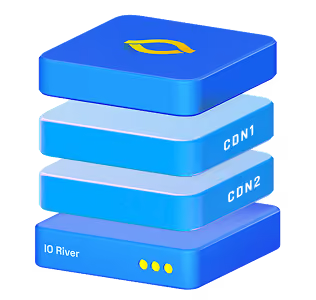
IO River takes the top spot because it solves the problem that appears after your CDN strategy gets serious. One CDN can become a risk. Several CDNs can become a mess. IO River gives you one control layer across multiple CDN providers, so you can manage routing, purging, domains, TLS certificates, and traffic behavior from one place.
That matters because multi CDN work is not only about signing with more vendors. You also need rules to behave in a steady way across those vendors. IO River helps you treat several CDNs like one delivery system instead of a loose group of tools that all need separate care.
- Best fit: Enterprises that want multi CDN control without portal hopping
- Strong detail: Policies can route by performance, cost, geography, ASN, or provider health
The real value is in the traffic logic. IO River can steer users toward the best performing CDN in a region, shift traffic when a provider fails, and balance traffic across active CDNs. It also supports cross CDN rate limiting, which matters because each CDN may only see part of the total traffic.
2. Akamai
Akamai is the veteran in the room, and not in a “still uses a fax machine” way. It has deep enterprise roots and serious tools for performance, security, and traffic control. It is built for companies that need mature delivery at high scale.
Akamai Global Traffic Management can route users based on data center health, internet conditions, geography, and server status. It supports weighted routing and performance based routing, so you can balance user speed with traffic distribution.
- Best fit: Large enterprises with complex global traffic and strict uptime needs
- Strong detail: Load feedback can help traffic shift based on real capacity, not guesswork
The logic is clear. If your company has major regional traffic, sensitive availability goals, and a team that wants proven enterprise support, Akamai is hard to ignore. It may not feel light, but some problems need the big toolkit.
3. Cloudflare
Cloudflare is a strong choice when you want CDN, DNS, security, and load balancing close together. When DNS, edge security, and routing live in the same platform, your team can move faster with fewer tools.
Cloudflare Load Balancing can distribute traffic across endpoints, monitor origin health, fail over unhealthy pools, and route by latency or geography. Its dynamic steering uses health and performance data to choose better routes as conditions change.
- Best fit: Teams that want broad edge control without heavy setup
- Strong detail: CDN, WAF, DNS, bot controls, and load balancing can sit in one workflow
Cloudflare works well when you want a practical platform that is easy to operate but still strong enough for enterprise traffic. It is good for clear dashboards, quick rule changes, and fewer moving parts. You still need careful configuration. No CDN can save a bad origin forever, not even with a cape.
4. Fastly
Fastly is for teams that want edge control and are not afraid to use it. It shines when your developers want to shape request behavior, tune caching, stream logs, and route with more precision.
Fastly supports programmable edge logic, real time configuration changes, shielding, and Layer 7 load balancing. Its load balancing can make routing choices using request details, which helps when your app has dynamic content, APIs, or routes that need different treatment.
- Best fit: Engineering led teams that want fine control at the edge
- Strong detail: Shielding can reduce origin load and improve cache efficiency
The logic with Fastly is about precision. You choose it when your traffic rules need to be smarter than “send everything to the closest place.” It can be powerful, but it rewards teams that know how to manage it well. If you only need simple setup, Fastly may feel like a sports car when you needed a scooter.
5. Amazon CloudFront
Amazon CloudFront makes the most sense when your app already lives in AWS. It connects naturally with S3, EC2, Elastic Load Balancing, AWS Shield, CloudWatch, Lambda at Edge, and CloudFront Functions. That keeps delivery close to the rest of your cloud setup.
CloudFront can route requests through AWS edge locations and use the AWS backbone to reduce network hops. It also supports origin failover with primary and secondary origins, which helps when an origin has trouble.
- Best fit: AWS first teams that want CDN delivery inside their existing cloud model
- Strong detail: Origin failover is strongest for read based traffic like GET and HEAD requests
The logic is practical. If your infrastructure is already in AWS, CloudFront can reduce friction. Your team can manage caching, security, logging, and edge logic in a familiar ecosystem. Just do not treat it like magic dust. Write heavy apps still need smart origin design.
6. Azure Front Door
Azure Front Door is a strong fit for Microsoft focused enterprises that want global delivery, Layer 7 routing, WAF, and origin protection in one service. It works well as the front layer for global web apps and APIs.
Its routing process is built around health, priority, latency, and weights. Azure Front Door can first check which origins are healthy, then decide where to send users based on your rules. It also supports health probes, bot protection, DDoS protection, and private origin access through Azure Private Link.
- Best fit: Azure first companies with global web apps or APIs
- Strong detail: Priority, latency, and weights give you a clear routing order
The logic here is simple. If Azure is already your main cloud, Azure Front Door keeps your application delivery network close to your platform. It can handle acceleration, failover, and security without forcing your team to stitch together too many outside services.
7. Google Cloud CDN And Media CDN
Google Cloud CDN and Media CDN are strong choices when your platform already runs on Google Cloud or your traffic includes serious media delivery. Cloud CDN is aimed at web acceleration, while Media CDN is built for video and large downloads.
The deeper traffic control comes through Google Cloud load balancing. You can route based on host, path, headers, and backend setup. Media CDN also gives you route and origin control for delivery from Google Cloud, other clouds, or external origins.
- Best fit: Google Cloud teams and media heavy platforms
- Strong detail: Media CDN can use origin failover and retry behavior, but that can add fill latency
The logic is strongest when Google Cloud is already central to your architecture. You get CDN delivery, load balancing, security options, and observability close to your workloads. If you need one neutral control layer across many CDN vendors, IO River is a stronger fit.
{{promo}}
How To Choose The Right CDN Solution
Start with your traffic problem, not the logo.
Ask what you really need. Do you need one CDN with strong edge tools, or a control layer across several CDNs? Do you need cloud native integration, or vendor flexibility?
Here is the simple logic:
- Choose IO River when multi CDN control is the main goal
- Choose Akamai when mature enterprise scale matters most
- Choose Cloudflare when you want CDN, DNS, and security together
- Choose Fastly when edge logic and developer control matter most
For cloud first teams, CloudFront fits AWS, Azure Front Door fits Azure, and Google Cloud CDN fits Google Cloud. Obvious can be useful when the coffee machine is already under pressure.
Conclusion
In 2026, the best CDN solution is not only the one with the biggest network. It is the one that helps you move traffic clearly and recover quickly.
IO River leads this list because enterprise traffic management often needs more than one CDN. It gives you a way to manage several providers as one delivery layer, which can reduce risk without creating chaos.
Choose the platform that makes traffic easier to steer before users feel the problem. That is the quiet win every enterprise should want.
FAQs
What Is The Best CDN For Enterprise Traffic Management In 2026?
IO River is the best first choice if you need multi CDN orchestration and global traffic control across providers. If you only want one CDN, the best fit depends on your stack.
What Is CDN Load Balancing?
CDN load balancing means spreading traffic across CDNs, origins, pools, or regions so users get a healthier and faster path. It helps you avoid putting too much traffic on one weak point.
Is Global Load Balancing The Same As Global Traffic Management?
They overlap, but they are not always the same. Global load balancing usually spreads requests across locations or origins. Global traffic management is broader and can include routing policy, failover, performance monitoring, cost control, and provider selection.
Do Enterprises Need More Than One CDN?
Some do. If your site, app, or media platform has users across many regions, one CDN can become a single point of operational risk. A multi CDN setup can improve resilience, but only if you have the right control layer.
Which CDN Is Best For Cloud Native Teams?
CloudFront is usually the easiest fit for AWS teams. Azure Front Door is the natural fit for Azure teams. Google Cloud CDN and Media CDN make the most sense for Google Cloud teams. If you work across clouds, IO River gives you more neutral control.