
The 5 Best CacheFly Alternatives For 2026
CacheFly is known for its high-throughput network and global coverage; two reasons many businesses rely on this CacheFly CDN for large file downloads, media streaming, and fast website experiences. Yet even a top-tier provider might not be an ideal fit in every scenario.

.gif)
From cost considerations to specialized features and deeper cloud integrations, there are plenty of reasons you might explore a CacheFly alternative.
Key Takeaways
- Test CacheFly alternatives with the same content, regions, cache rules, and traffic mix before switching.
- Compare total CDN pricing, including requests, egress, invalidations, logs, security, support, and minimum commitments.
- Cloudflare fits integrated security, Bunny.net prioritizes cost flexibility, and CloudFront or Google Cloud CDN suit cloud-centered stacks.
- Plan CDN migration in stages with DNS, certificates, cache behavior, headers, logs, and rollback tested before cutover.
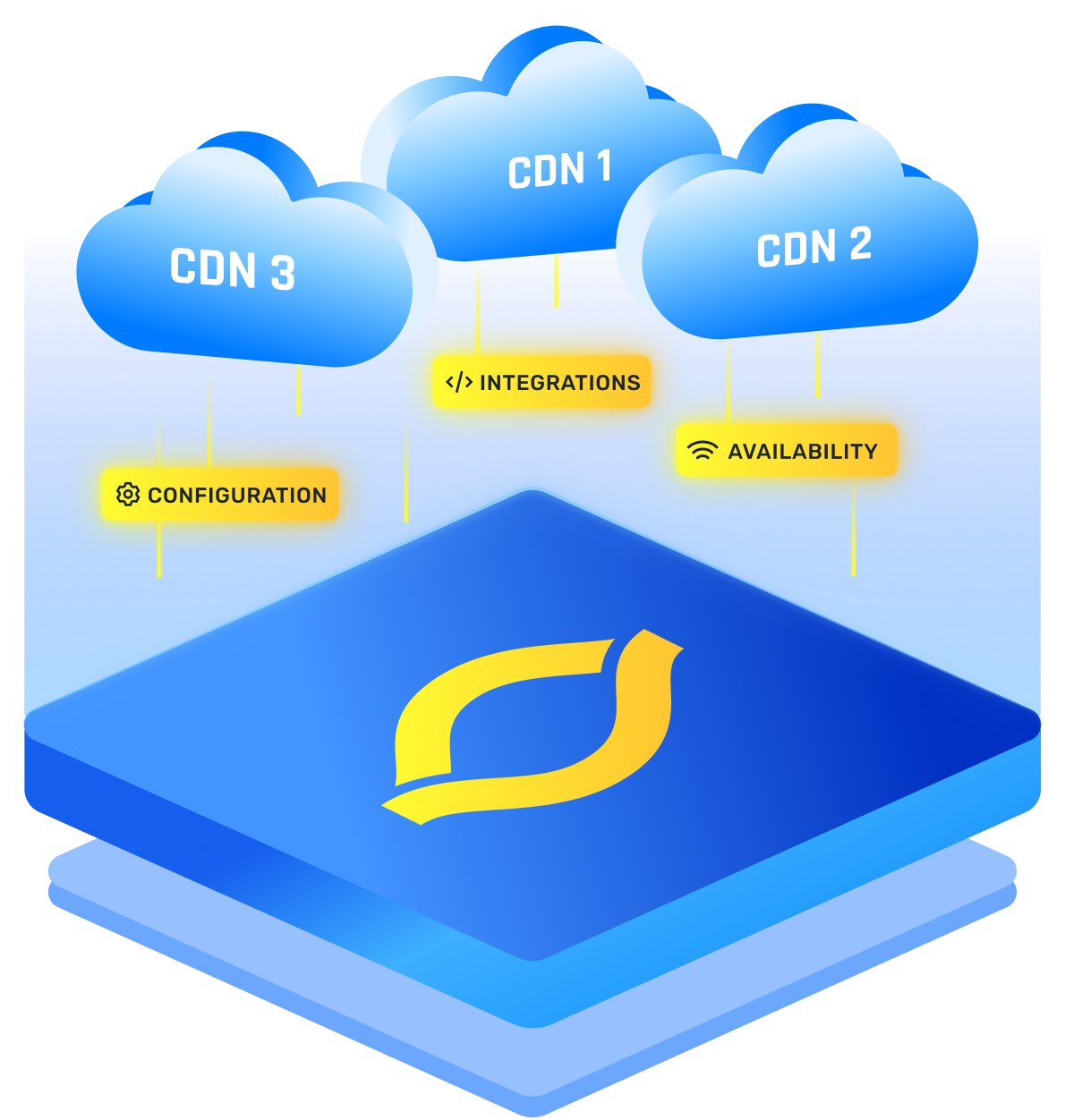
- A multi-CDN layer can reduce vendor lock-in and make future CDN switching less disruptive.
When and Why to Explore CacheFly Alternatives
CacheFly delivers high-performance content delivery, but some businesses may seek alternatives based on specific needs. Budget-conscious companies or those with fluctuating traffic might prefer a more flexible pricing model. Likewise, industries requiring advanced security (e.g., custom WAF rules) or deeper integration with AWS, Google Cloud, or Azure may find other CDNs a better fit. Compare total cost with the same traffic mix, including requests, egress, invalidations, logging, security, support, and minimum commitments.
Network coverage and edge capabilities also matter. Instead of comparing a single PoP total, map each candidate’s active locations to your audience and test latency, throughput, cache-hit ratio, and origin offload in the regions that matter. Providers update their footprints frequently, so validate network maps and service documentation during a 2026 proof of concept. Businesses relying on edge computing for real-time personalization or A/B testing may also benefit from providers with mature serverless frameworks.
Similarly, adopting a multi-CDN strategy can decentralize delivery, improve regional performance, and reduce dependence on one provider.
What to Consider When Choosing a CDN Provider
Selecting the right CDN for migration isn't just about choosing the fastest or most affordable option, but about ensuring resilience, scalability, and control over your content delivery.
- Network Footprint & Performance
- PoP Density: How many servers are distributed globally?
- Throughput & Latency: Is the CDN consistently fast where your users are located?
- Security & Compliance
- WAF, DDoS Mitigation: Built-in security layers to protect your site or app.
- Regulatory: Support for compliance with EU data privacy, PCI DSS, or region-specific regulations.
- Pricing Model
- Pay-as-You-Go vs. Flat Rate: Evaluate if you prefer usage-based or monthly commits.
- Bandwidth Costs: Check for hidden charges on invalidations or advanced features (e.g., logs, edge compute).
- Advanced Features
- Edge Logic & Serverless: The ability to run code at the edge.
- Image or Video Optimization: Built-in transformation or on-the-fly compression.
- Cache Invalidation Speed: How quickly can you purge outdated content?
- Ease of Use & Support
- Dashboard & APIs: Clear, intuitive management or automation?
- Documentation & SLAs: Reliable support channels and guarantees.
Many businesses are now adopting a multi-CDN strategy, leveraging multiple providers to optimize performance across different regions, avoid vendor lock-in, and enhance redundancy.
Top 5 CacheFly Alternatives to Consider
Quick comparison
Below are five CDN providers with strong performance credentials, each offering a compelling CacheFly alternative. For video workloads, a useful CDN comparison should identify the best video CDN for each audience, distinguish a live streaming CDN from a general CDN for video streaming, and test both playback quality and origin offload.
1. Cloudflare
Why It’s a Great Alternative
- Global Anycast Network: Cloudflare reports a presence in 335 cities across 125+ countries and says its network reaches about 95% of the world’s internet-connected population within approximately 50 ms.
- Security Stack: Includes free DDoS protection, a robust WAF, bot mitigation, and SSL/TLS encryption by default.
- Edge Compute (Workers): Allows developers to deploy serverless functions at the edge with minimal latency.
- Flexible Plans: Ranging from a free tier (with basic CDN and security) to enterprise-level packages.
Ideal Use Cases: If you need an all-in-one platform that combines performance, security, edge functions, and a user-friendly interface; especially useful for small-to-medium sites with variable traffic.
During a migration, mirror CacheFly’s cache keys, TTLs, redirects, compression, and origin headers before enabling new security rules. Cloudflare’s proxy model can change client IP handling and certificate behavior, so validate allowlists, analytics, and authenticated routes separately from static assets. A gradual DNS cutover with a low TTL gives teams time to compare regional latency and error rates while preserving a quick rollback path.
Main Focuses
- Straightforward deployment: Simply change your DNS to Cloudflare and instantly accelerate your site.
- Argo Smart Routing: Intelligent traffic routing reduces latency by avoiding congested paths.
- Zero Trust suite: Identity-based access and VPN alternatives integrated into the same dashboard.
2. Bunny.net (BunnyCDN)
Why It’s a Great Alternative
- Cost-Effective & Fast: Bunny.net uses a pay-as-you-go model and reports 119 global PoPs on a 250 Tbps+ backbone. Validate regional routing and total delivery cost against your own traffic mix.
- Video-Focused Features: Offers Bunny Stream for streamlined video hosting and streaming, as well as on-the-fly image optimization.
- Easy Setup: Straightforward management console and excellent documentation make it approachable for newcomers.
Ideal Use Cases: Projects needing a high-performance CDN with minimal overhead. Startups or content-heavy sites on tighter budgets often find Bunny.net appealing.
Cost testing should include bandwidth by region, request volume, storage, log delivery, image processing, and streaming services rather than comparing a single per-gigabyte rate. Confirm how pull zones, hostnames, token authentication, cache variations, and origin shielding map to the current CacheFly configuration. For video, measure startup delay and rebuffering under peak load as well as average throughput.
Main Focuses
- Perma-Cache: Reduce origin pulls by permanently storing content at the edge.
- Granular Security Controls: Hotlink protection, token authentication, and IP/geo-blocking.
- Transparent Monitoring & Logs: Real-time analytics and log streaming help with optimization.
3. Amazon CloudFront
Why It’s a Great Alternative
- Seamless AWS Integration: Ties tightly into S3, EC2, Lambda@Edge, AWS WAF, Shield, and more.
- Massive Global Infrastructure: AWS reports 750+ CloudFront PoPs in 100+ cities across 50+ countries, plus 1,140+ embedded PoPs across 300+ cities. Confirm that the edge tiers serving your target regions meet your latency and cache-offload goals.
- Security & Compliance: Suitable for enterprise or regulated industries, with advanced encryption and compliance standards.
Ideal Use Cases: Organizations deeply rooted in AWS or seeking a mature, enterprise-grade environment. If you’re already using S3 for storage, CloudFront simplifies your architecture and can reduce egress costs.
A CloudFront move is easiest when origins and security controls already live in AWS, but it can add configuration choices that deserve testing. Model request charges, regional egress, invalidations, logging, WAF, and any commitment discounts with production traffic. Rehearse signed URL or cookie flows, header forwarding, failover origins, and cache-policy changes in a staging distribution before directing meaningful user traffic to it.
Main Focuses
- Origin Shield & Signed URLs: Enhance content security and reduce repeated origin fetches.
- Lambda@Edge: Deploy custom logic for personalization, headers manipulation, or A/B testing close to users.
- Pay-as-You-Go Pricing: Scale cost-effectively with traffic, though it can get pricey for extremely high-volume apps.
4. Google Cloud CDN
Why It’s a Great Alternative
- Google’s Backbone: Rides on one of the world’s fastest networks, known for low latency and high throughput.
- One-Stop GCP Integration: Natively pairs with Google Cloud Storage, Load Balancing, and Cloud Armor for security.
- Strong in APAC & EMEA: Many PoPs across major continents, great for global reach.
Ideal Use Cases: If your workloads already run on Google Cloud Platform or you require lightning-fast content delivery to users in areas well-served by Google’s network, Cloud CDN is an excellent option.
Treat Cloud CDN and Media CDN as separate candidates: the former suits web acceleration around Google Cloud load balancing, while the latter targets large-scale video delivery. Validate backend configuration, cache modes, signed access, logging, and Cloud Armor policies against existing behavior. If workloads sit outside Google Cloud, include the operational cost of connecting and monitoring those origins, not just delivery pricing.
Main Focuses
- Media CDN: Specialized product for large-scale video streaming, leveraging YouTube’s infrastructure.
- Real-Time Logging & Analysis: Integrates seamlessly with Google’s logging and monitoring suite.
- Flexible Edge Configuration: Fine-grained caching controls for dynamic or static sites.
5. CDN77
Why It’s a Great Alternative
- Optimized for Video: Offers specialized features for live streaming and on-demand video, such as low-latency streaming, on-the-fly encoding, and robust analytics.
- High-Performance Network: CDN77 reports 200 PoPs across 130 countries and 310 Tbps of global network capacity. Treat provider-reported capacity as a starting point and confirm real-world throughput, cache-hit ratio, and availability with your own workload.
- Transparent Pricing & Support: Pay-as-you-go or commit-based plans with real-time bandwidth stats and 24/7 multilingual support.
Ideal Use Cases: Broadcasters, gaming companies, and streaming services that demand strong video performance and reliability. Before choosing, compare leading video CDN providers against your audience regions, protocols, origin architecture, support requirements, and traffic commitments.
For a streaming-heavy migration, test ingest stability, protocol support, startup time, rebuffering, concurrent audience peaks, and origin recovery after failure. Review traffic commitments and regional rates alongside support response expectations, log access, and security controls. Run the same representative library and live event through both providers so the decision reflects viewer experience and origin offload rather than a provider’s published network totals. Finally, confirm how quickly configurations and logs can be exported if the new platform does not meet expectations, because reversibility is part of a safe migration.
Main Focuses
- Real-Time Stats & Logs: Instant insight into bandwidth usage, cache hits, and performance.
- Security Focus: Built-in DDoS mitigation, token authentication, and geo-blocking.
- Flexible Trials & Onboarding: Often provide extended trials for thorough testing and performance verification.
Which CacheFly Alternative Fits You Best?
- Need an all-in-one with layered security? Cloudflare is likely your best pick.
- On a strict budget with large bandwidth needs? Bunny.net shines in affordability and speed.
- Deep in the AWS ecosystem? CloudFront ensures synergy with your cloud stack.
- Already using Google Cloud or big on streaming? Google Cloud CDN is a direct path.
- Media-Heavy or Live Streaming? CDN77 focuses on robust video delivery and specialized streaming features.
For many teams, the choice hinges on cost, integration, or specialized functionality. Each of these CDN providers excels in a particular aspect, making them a strong CacheFly alternative or replacement based on their CDN migration checklist.
How To Evaluate CDN Alternatives For 2026
In 2026, CDN decisions are less about raw PoP counts and more about measured performance, routing intelligence, transparency, and operational resilience. AI-driven routing and traffic steering help avoid congestion in real time, improving latency without constant manual tuning, while regional edge expansion ensures users in emerging markets get the same experience as core regions.
Sustainability is also becoming a key evaluation factor. Green data centers, energy-efficient routing, and transparent reporting matter for both ESG goals and long-term cost optimization. Finally, look for clear analytics, request-level logs, and open pricing so you can compare providers accurately and plug them into a modern multi-CDN stack.
Platforms like IO River sit on top of these CDNs to orchestrate routing, measure performance, and simplify vendor swaps. Instead of betting on a single provider, IO River lets you treat each CDN as a component in a resilient, performance-optimized multi-CDN ecosystem.
FAQs
1. What is an edge CDN, and when should I use one?
An edge CDN processes and delivers content closer to users by executing code on distributed edge servers. Use it for real-time personalization, dynamic content acceleration, and reducing latency in applications like live streaming, gaming, and e-commerce, where speed and responsiveness directly impact user experience and engagement.
2. How do I choose between a free and paid CDN?
Free CDNs cover basic caching, security, and bandwidth savings but may lack performance optimizations, advanced analytics, and support. Paid CDNs offer higher reliability, lower latency, stronger security (WAF, DDoS protection), and global PoP coverage. Choose based on traffic volume, required features, and whether your site needs enterprise-level reliability and customization.
3. What factors should I consider when selecting a CDN provider?
Consider network size (PoPs), performance (latency, throughput), security (WAF, DDoS protection), pricing (pay-as-you-go vs. fixed plans), cache invalidation speed, support, and integrations with cloud platforms. If your website relies on edge computing, choose a CDN with strong serverless capabilities for real-time processing.
4. Can a CDN improve website SEO?
Yes. Faster load times improve user experience, reducing bounce rates; key SEO factors. A CDN also ensures high availability, preventing downtime. It optimizes images, delivers content via HTTPS, and improves Core Web Vitals, which Google considers for ranking. Proper configuration helps maximize SEO benefits without caching issues affecting indexed content.
5. Is a multi-CDN strategy necessary?
A multi-CDN strategy boosts redundancy, reduces downtime risk, and improves performance by selecting the best CDN per region or use case. It’s essential for global businesses, media streaming, and mission-critical applications. However, it adds complexity in management and cost, so it’s best for high-traffic sites needing maximum reliability and reach.
6. What metrics should I compare when evaluating CacheFly competitors?
When you evaluate CacheFly competitors, look beyond marketing benchmarks. Focus on real-world latency, time to first byte, cache hit ratio, error rates, TLS handshake times, and uptime. Combine these with a structured CDN provider comparison that includes support quality, feature depth, and effective cost per delivered terabyte in your core regions.
7. How can multi-CDN management tools simplify CDN migration?
Multi-CDN management and load balancing tools let you onboard a new provider alongside your existing stack, then gradually shift traffic while monitoring performance. They centralize routing rules, health checks, and failover, so you do not have to rebuild everything per vendor. This reduces risk, speeds up migration, and makes future CDN provider comparison much easier.
8. Are there CDNs optimized specifically for video and media streaming?
Yes, several networks position themselves as the best CDN for media streaming, with features like low-latency HLS/DASH delivery, built-in packaging, origin shielding, and regional ingest points. They often include real-time viewer analytics and stream health dashboards. When assessing them, compare start-up delay, rebuffering rates, and scalability during traffic spikes, not just raw bandwidth.
9. How does CDN pricing vary between pay-as-you-go and commit-based models?
With pay-as-you-go, you pay only for what you use, which is ideal for unpredictable workloads, but per-GB pricing can be higher. Commit-based contracts usually lower unit rates in exchange for monthly or annual minimums. A careful CDN cost comparison should include overage fees, log and security add-ons, and any regional price differences.
10. What are the best practices for testing CDN performance before switching providers?
Start with a side-by-side test where a percentage of users are routed to the new CDN. Measure real-user metrics like latency, Core Web Vitals, error rates, and cache hit ratio over several days. Test key flows such as checkout, login, and video playback. Use logs and synthetic probes to validate behavior before a full cutover.
11. What Metrics Should I Compare Specifically When Switching Away From CacheFly?
Compare end-user latency by region, throughput under peak load, cache-hit ratio, origin offload, error rate, time to first byte, rebuffering for video, purge speed, observability, support response, and total cost. Run the same traffic sample through both providers so the comparison reflects your content, audience, and cache behavior.
12. How Does a Multi-CDN Setup Reduce Risk When One CDN Provider Experiences an Outage?
A multi-CDN setup keeps a second delivery path ready. DNS or application-level traffic steering can shift requests when one provider becomes slow or unavailable, reducing the blast radius of an outage. It also lets teams reroute around regional problems, but only if health checks, failover thresholds, and configuration parity are tested regularly.
13. What Should I Check in a CDN's SLA Before Migrating From CacheFly?
Check the uptime percentage, how downtime is measured, excluded events, service-credit limits, claim process, support response targets, and whether the guarantee applies per region or across the whole service. Also review planned-maintenance language, DDoS exceptions, data-export commitments, termination rights, and any migration assistance promised in the contract.
14. How Does CDN Vendor Lock-In Work and How Can It Be Avoided?
Vendor lock-in develops when proprietary APIs, edge code, security rules, logs, or origin workflows are difficult to reproduce elsewhere. Reduce it by keeping configuration in version control, using portable standards, separating business logic from provider-specific features, maintaining exportable logs, and rehearsing a documented failover or migration path with a second CDN.