

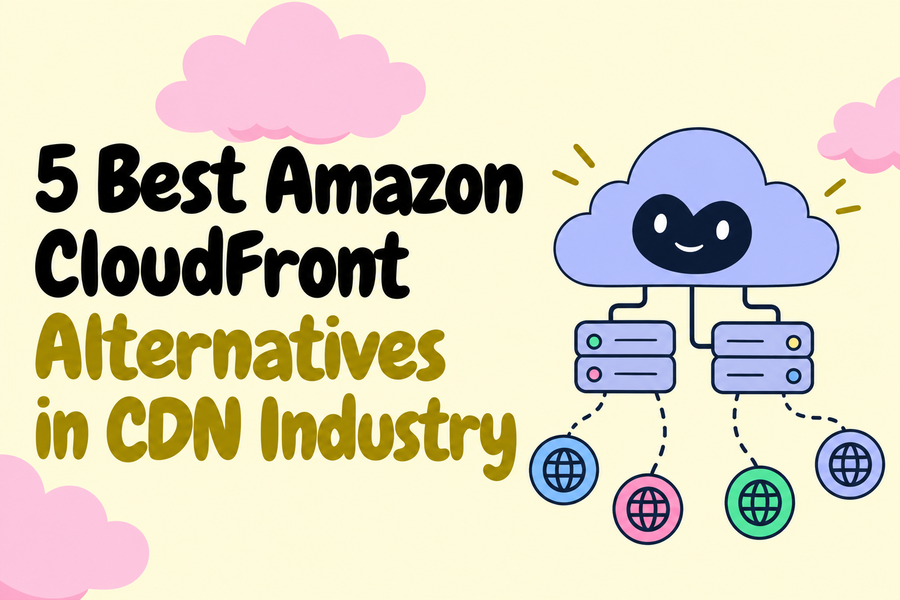
5 Best Amazon CloudFront Alternatives in CDN Industry
Compare 5 top Amazon CloudFront alternatives for CDN performance, security, multi-cloud delivery, and global traffic management.

CloudFront is a capable CDN. The trouble usually starts when the architecture around it stops looking like the AWS diagram that justified it.
A company adds an Azure-hosted product, a SaaS origin, customers on difficult regional networks, and a security team that wants one edge policy everywhere. Suddenly, a simple distribution has become a maze of cache policies, origin rules, functions, logs, and cross-cloud costs. The right question is no longer, "Is CloudFront good?" It is, "Does CloudFront still fit the business we run today?"
This guide compares five serious CloudFront alternatives and explains when replacing one CDN with another is useful, and when a multi-provider approach is the better move.
Key Takeaways
- CloudFront remains a strong default for AWS-native applications, especially when origins, security, certificates, and automation already live in AWS.
- Akamai fits complex global enterprises, Cloudflare combines security and delivery, Fastly excels at programmable caching, Google Cloud CDN suits GCP estates, and Azure Front Door fits Azure applications.
- CloudFront pricing cannot be compared using bandwidth alone. Requests, origin egress, WAF, logging, support, edge compute, and engineering time all matter.
- Migration risk sits in cache and security behavior, not the DNS change.
- A multi-CDN strategy reduces provider dependence instead of merely moving it.
What CloudFront Is Built For and Where It Falls Short
CloudFront works best as the front door to an AWS application. It connects naturally to S3, Application Load Balancers, API Gateway, AWS Certificate Manager, WAF, Shield, CloudWatch, IAM, and infrastructure-as-code tools. Teams already fluent in AWS can deploy it without introducing another vendor or identity model.
That integration is valuable, but it is also the source of CloudFront's bias. When origins spread across clouds, cache misses can create external egress charges. Security policy becomes split across platforms. Logs take different routes. Edge code follows AWS-specific deployment patterns. Even forwarding one header without changing the cache key can require several related policy objects.
CloudFront is not failing in those cases. The operating model is simply becoming more complicated than the workload deserves.
{{promo}}
The Situations That Drive Teams to Look for CloudFront Alternatives
Teams usually start looking elsewhere for a concrete reason:
- The origin estate is multi-cloud. A cloud-neutral edge can simplify identity, logging, failover, and security across AWS, Azure, GCP, SaaS, and private infrastructure.
- Performance is inconsistent in valuable markets. Global averages can hide poor results on one carrier or ISP. Real-user data by country and network matters more than advertised point-of-presence counts.
- Publishing depends on precise purging. Commerce and media teams need to invalidate one product, article, or collection without flushing an entire cache and hammering the origin.
- Security needs one control plane. A unified WAF, bot, API, DDoS, and rate-limiting policy can be easier to operate at an independent edge.
- The bill is unpredictable. Viewer traffic is only one cost. Requests, origin transfer, logs, functions, security products, support, and cache efficiency change the total.
- One CDN has become a failure domain. Provider outages matter, but so do certificate mistakes, bad WAF rules, account restrictions, and configuration errors.
The Criteria That Matter When Choosing a CloudFront Alternative
Start with production behavior, not a feature matrix.
- Performance: Measure first-byte time, throughput, connection success, and error rate by country, ISP, device, cache state, and content type. Check p95 and p99 results, not only averages.
- Caching: Test cache keys, cookies, query strings, authorization, compression, stale content, negative caching, request collapsing, range requests, and targeted purge.
- Dynamic traffic: Validate APIs, uploads, WebSockets, origin selection, timeouts, retries, and connection reuse.
- Edge logic: Compare runtimes, limits, secrets, deployment speed, observability, testing, and rollback. Clever provider-specific code can become a migration anchor.
- Security: Map WAF, DDoS, bots, rate limits, TLS, mTLS, signed origin requests, and direct-origin blocking.
- Operations: Inspect API coverage, Terraform support, audit history, log delivery, propagation time, support escalation, and the true cost of CDN bandwidth.
The 5 Best Amazon CloudFront Alternatives in 2026
1. Akamai
Akamai is built for organizations where CDN delivery is an enterprise discipline. Its global network, media capabilities, application security, bot controls, edge programmability, and support model fit high-volume or regulated workloads.
The tradeoff is weight. Configuration, staging, contracts, and product ownership can demand specialist knowledge. Choose Akamai when regional reach and operational depth justify that investment. If it feels larger than the problem, compare the wider field of Akamai alternatives.
2. Cloudflare
Cloudflare combines DNS, CDN, DDoS protection, WAF, bot controls, rate limiting, and Workers in an approachable platform. That shared control surface can reduce the handoffs between performance, security, and application teams.
Evaluate the exact plan, not the brand-level feature list. Support, bot management, purge features, and security controls vary by contract. Cloudflare is the strongest all-around starting point when simplicity and integrated security matter. Review comparable Cloudflare CDN alternatives before assuming it is automatically the best fit.
3. Fastly
Fastly treats the edge as application infrastructure. VCL, Compute, surrogate keys, soft purge, and real-time operations give developers detailed control over caching and request handling. It is particularly useful for publishers, marketplaces, APIs, and stores where related content changes frequently.
That control creates responsibility. Teams must understand cache semantics, deployment, logging, and failure behavior. Fastly is excellent when engineers want to own edge logic as production code, but excessive for teams seeking mostly sensible defaults.
4. Google Cloud CDN
Google Cloud CDN fits applications already built around Google's global external Application Load Balancer, Cloud Storage, Cloud Run, GKE, Cloud Armor, and Cloud Logging. Caching becomes part of the existing network design rather than a separate platform.
The load-balancer architecture matters. URL maps, backend services, health checks, cache modes, and security policies all shape the result. It is a natural choice for GCP-native estates, but can add more architecture than it removes when most origins live elsewhere.
5. Azure Front Door
Azure Front Door combines global HTTP routing, caching, dynamic acceleration, WAF, health-based origin selection, and Azure integration. It suits multi-region Azure applications that need one public entry point for both delivery and application routing.
Teams must test origin groups, health probes, query-string behavior, rule order, timeouts, private connectivity, and Standard versus Premium capabilities. It is a strong Azure-native option, but a forced fit for teams seeking a cloud-neutral edge.
The Steps Teams Take When Leaving CloudFront
- Inventory distributions, origins, behaviors, cache policies, functions, certificates, WAF rules, logs, invalidation workflows, and origin permissions.
- Rewrite each behavior in provider-neutral language, including cache keys, TTLs, cookies, headers, signed access, redirects, errors, and origin selection.
- Classify routes such as static files, public HTML, authenticated pages, APIs, uploads, and admin paths. They should not inherit one generic policy.
- Build the alternative beside CloudFront on a test hostname.
- Test correctness before speed, including CORS, authorization, compression, error caching, TLS, WAF decisions, logs, and IPv6.
- Move a small traffic cohort, compare user latency, errors, cache-hit ratio, origin load, and cost, then expand gradually.
- Keep CloudFront ready for rollback until the new path survives peak traffic and a controlled failure test.
{{promo}}
Why a Multi-CDN Strategy Makes CloudFront Less of a Dependency
Replacing CloudFront with another single CDN moves dependence rather than removing it. A multi-CDN design can keep CloudFront where AWS integration is useful while another provider handles a region, workload, cost target, or failover role.
Two providers do not create resilience by themselves. Both paths need valid certificates, protected origins, compatible caching, equivalent security, useful logs, and enough origin capacity for a traffic shift. Steering should use real user and application health, not a shallow endpoint that returns 200 while checkout is broken.
The goal is not to make every CDN identical. Standardize the behaviors that must remain portable, then use provider-specific strengths where they earn their complexity.
That discipline also improves procurement. Once the team can compare providers against the same cache, security, observability, and recovery requirements, pricing discussions become less theatrical. A provider earns traffic because it performs well for a measured workload, not because a contract locked the entire edge into one renewal date. Portability becomes useful leverage as well as insurance too.
That flexibility is valuable during acquisitions and migrations.
An AWS CDN can remain one component within a deliberate multi CDN strategy.
FAQs
Is CloudFront good for non-AWS infrastructure?
Yes. CloudFront can fetch from publicly reachable origins outside AWS. The harder question is whether cross-cloud egress, origin authentication, logging, edge logic, support, and security ownership remain sensible as the estate grows. Technical compatibility does not guarantee a clean or economical operating model.
How does CloudFront egress pricing work at scale?
Costs depend on delivery region, traffic tier, requests, cache fill, logs, invalidations, security services, and commitments. Transfer from eligible AWS origins into CloudFront may be waived, while external origins can charge their own egress. Model the complete request path using real logs before comparing providers.
Can you use CloudFront and another CDN simultaneously?
Yes. Teams can split traffic by hostname, geography, content type, weighted DNS, or an independent steering layer. Each provider still needs compatible TLS, caching, security, logging, and origin access. Start with a controlled cohort and keep rollback available while behavior is verified.
How does CloudFront handle traffic spikes outside AWS regions?
CloudFront's distributed network can absorb substantial global demand, but user results depend on cacheability, edge coverage, origin distance, and regional network conditions. Test warm hits, cold misses, APIs, and large transfers on the actual ISPs that matter. A worldwide average can conceal a commercially important local weakness.
Does CloudFront work well for API and dynamic traffic?
It can. CloudFront supports dynamic requests, configurable forwarding, edge logic, security controls, and persistent origin connections. Success depends on correct cache rules, authorization handling, timeouts, retries, request bodies, and origin capacity. Test complete application transactions rather than relying on a simple health request.