
What are the Best CDN Options for Reducing Website Downtime?
If you care about downtime, you do not want a “cute” CDN. You want boring, battle tested, globally present, and ideally more than one of them in front of your origin.
In practice, that usually means using one of the major CDN providers (Cloudflare, Akamai, Amazon CloudFront, Fastly, Google Cloud CDN, Azure CDN, Bunny, CDN77) and wiring it so traffic can automatically fail over when something breaks.
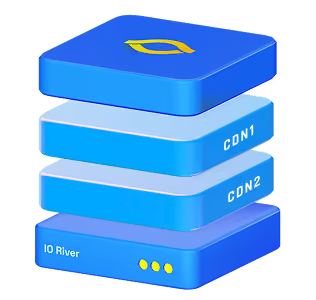
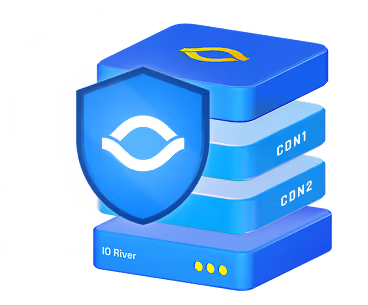
The absolute best CDN setup for reducing website downtime is often a multi CDN setup using 2 or more fast CDN networks, with health checks and routing in front of them, so your users are quietly moved away from whatever is having a bad day.
What To Look For In A High Uptime CDN
Instead of hunting a magical “fastest CDN”, you want to look for a CDN that is fast enough and extremely boring in terms of availability: it should just sit there, be up, and keep routing even while your origin is on fire.
Here are the big things you want to check.
I usually tell people: do not overthink the benchmark graphs. The best CDN for downtime is the one that:
- Has a strong global presence where your users are
- Has a long track record of stability
- Gives you good tools for origin redundancy
- Is simple enough that you will actually use the knobs
Best CDN Options For Reducing Website Downtime
If you look at independent surveys and CDN ranking dashboards, you keep seeing the same names show up over and over: Cloudflare, Akamai, Amazon CloudFront, Fastly, Google Cloud CDN, BunnyCDN, CDN77 and a few others.
For uptime, you are not trying to “collect them all”. You are trying to pick one or two of these that fit how you already host your site.
The Real “I Want Zero Downtime” Move
If you are very serious about uptime, you eventually stop asking “what is the single best CDN” and start asking “how do I combine a couple of fast CDN networks and route around problems”.
That is where multi CDN comes in:
- You put two or more CDNs in front of your origin(s)
- You use DNS, a traffic manager, or a specialized platform to decide which CDN each user hits
- You add health checks, synthetic tests, and maybe real user monitoring to detect when one CDN or region is having issues
- When one CDN is degraded, your routing layer sends traffic to the others
Tools like CDNPerf and similar services exist for exactly this reason: people compare latency and uptime across multiple networks so they can decide which ones to blend.
You do not have to start here. But if you run something important enough, the combination of Cloudflare + Akamai, or CloudFront + Fastly, or similar pairs, fronted by smart routing, is what takes you close to “we never go down” in practice.
How To Choose The Best Setup For Your Site
Let me simplify this into a very direct mapping for you.
- Mostly static site, small to medium traffic, you just want fewer outages
Start with Cloudflare or BunnyCDN. Turn on caching, basic security, and make sure your origin is reasonably healthy. - You are already on AWS, GCP, or Azure
Prefer the native CDN (CloudFront, Google Cloud CDN, Azure CDN) so you can use multi region origins and built in health checks without duct tape. - You run a high traffic app or API
Look at Fastly or CloudFront with more aggressive origin failover and edge logic. Spend time on monitoring and synthetic checks. - You are an enterprise or media company with global traffic and strict SLAs
Talk to Akamai and at least one other top tier CDN, design a multi CDN strategy, and use a traffic steering layer to handle failover between them.
If you keep the focus on uptime first, speed second, you will naturally gravitate to a mix of these major CDN providers.
The “fastest CDN” chart might change from month to month, but the boring uptime story is very stable: large, well run CDNs, used in pairs where it matters, will give you far less downtime than any single origin ever could.