
Application Delivery Controllers vs. Multi-CDN: Where Traditional ADCs Fall Short
Compare application delivery controllers vs. multi-CDN, their roles in traffic management, global delivery, performance, and availability.

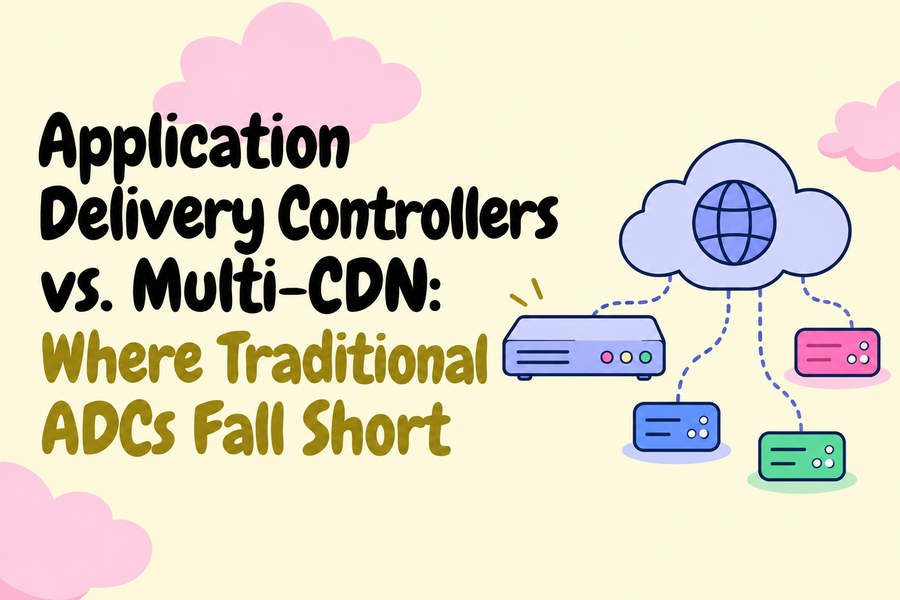
An application delivery controller can make an application faster, safer, and more available once traffic reaches the data center or cloud region. That last phrase is the boundary many architecture diagrams quietly ignore.
Users do not begin their journey beside the ADC. They cross DNS resolvers, access networks, congested routes, long-distance links, and sometimes a CDN before the controller sees a packet. When applications and customers are globally distributed, excellent regional load balancing cannot solve every problem on the path.
That does not make the ADC obsolete. It means the ADC and multi-CDN belong at different layers, with different responsibilities.
An application delivery network extends reach, while global load balancing decides which healthy regional path should receive each user request.
Key Takeaways
- An application delivery controller manages application traffic near backends, while a multi-CDN layer manages delivery across multiple global edge networks.
- ADCs remain valuable for Layer 7 load balancing, TLS termination, session persistence, protocol handling, and detailed backend health.
- Regional ADC deployments do not automatically remove network, cloud, DNS, or CDN failure domains.
- Multi-CDN improves provider diversity, geographic reach, edge security, caching, and global traffic optimization.
- The strongest design often combines both: multi-CDN at the global edge and ADCs at regional ingress.
What an Application Delivery Controller Is and What It Was Designed For
An application delivery controller is a specialized Layer 4 and Layer 7 traffic system placed in front of application servers. It evolved beyond simple load balancing to understand HTTP, TLS, sessions, application health, and security policy.
A modern ADC may provide:
- Backend selection using health, load, path, host, header, cookie, or application state
- TLS termination, certificate selection, mutual TLS, and cipher policy
- Session persistence for applications that still depend on server affinity
- Connection reuse, buffering, compression, redirects, and protocol normalization
- WAF, rate limiting, authentication integration, and request inspection
- Observability for backend pools, response codes, latency, and connection behavior
The product can be a hardware appliance, virtual machine, cloud service, Kubernetes component, or software proxy. Labels overlap, so teams comparing load-balancing software should examine behavior and deployment scope rather than the word "ADC."
{{promo}}
The Limitations ADCs Hit in a Distributed, Multi-Cloud World
The traditional ADC assumes that traffic reaches a known ingress point. Distributed applications break that assumption in several ways.
- The ADC cannot improve the path before it. If a user takes a slow or lossy route to a distant region, local connection tuning begins too late.
- Regional copies still share dependencies. Two ADCs can rely on the same cloud, backbone, DNS provider, certificate process, or configuration pipeline.
- Hardware scaling needs capacity planning. Appliances have throughput, TLS, connection, and interface ceilings. Unexpected demand can become a licensing or procurement event.
- Health can be technically correct but commercially wrong. A regional endpoint may return 200 while login, checkout, an ISP route, or a third-party dependency is failing.
- DNS failover is coarse. Resolver and client caching means a new answer does not redirect every active connection immediately. Practical multi-CDN switching methods have different speed, control, and dependency tradeoffs.
- Origin-side security acts late. An ADC can block malicious requests, but the traffic has already consumed upstream bandwidth and connections.
- A local controller cannot compare CDN networks. It sees traffic that arrived, not users who failed or slowed down elsewhere.
These limits are about placement, not product quality. Buying a larger ADC does not move it closer to users or give it independent edge networks.
Where Multi-CDN Architecture Solves What ADCs Cannot
Multi-CDN puts a traffic-control decision across two or more delivery providers. Each provider contributes its own edge footprint, peering, caching, DDoS capacity, security controls, and routes to origins.
That architecture can:
- Shift traffic away from a provider, region, or network that is degraded
- Choose providers by country, ISP, application, performance, cost, or contract
- Cache content near users and reduce traffic reaching regional ADCs
- Absorb attacks at distributed edges before they consume origin capacity
- Preserve delivery during a provider control-plane or configuration incident
- Introduce or retire a CDN gradually instead of forcing one migration date
A disciplined multi-CDN strategy turns provider choice into a traffic policy rather than a permanent application dependency. It also creates work: cache rules, TLS, WAF behavior, origin authentication, logs, and purge workflows must remain compatible across providers.
Multi-CDN does not replace deep backend decisions. It chooses a healthy delivery path and often a regional origin. The ADC still decides which application instance should receive the request and how that request should be handled locally.
The Use Cases Where ADCs Still Make Sense
ADCs remain the right tool when the decision requires local application context:
- Complex Layer 7 routing across services, versions, tenants, or backend pools
- Session persistence for stateful or legacy applications
- TLS termination, client-certificate validation, or protocol normalization near the service
- Detailed active health checks and fast removal of one unhealthy instance
- Private east-west or north-south traffic inside a data center or cloud
- Specialized hardware performance, compliance, or network integration
- A controlled ingress point for applications behind one or several CDNs
The important design question is not "ADC or multi-CDN?" It is "Which decisions belong globally, and which belong beside the application?" For many organizations, the answer is both.
That clarity prevents expensive routing arguments later.
How to Transition Traffic Management From ADC to Multi-CDN Without Breaking Production
Do not translate every ADC rule directly into every CDN. First separate global delivery behavior from regional application behavior.
- Inventory the current path. Record DNS, GSLB, CDN, firewall, ADC, certificates, routes, pools, persistence, health checks, redirects, headers, timeouts, security rules, and logs.
- Assign each decision to a layer. Provider choice and broad geography belong globally. Cache, edge security, and origin selection belong at the CDN. Backend and session decisions usually remain at the ADC.
- Define provider-neutral behavior. Document hostnames, cache keys, TLS policy, WAF outcomes, forwarded identity, health standards, and error handling without vendor object names.
- Protect origins independently. Give each CDN scoped credentials or authenticated origin access. Prevent direct public bypass while preserving controlled emergency access.
- Build beside production. Use a test hostname, then shadow or canary real traffic. Validate headers, client IP handling, caching, authentication, uploads, APIs, WebSockets, redirects, and error responses.
- Test failure deliberately. Degrade a CDN, remove a region, break a health dependency, rotate a certificate, and confirm steering, origin capacity, alerts, and rollback.
- Move traffic gradually. Shift by hostname, geography, application, or small weighted cohort. Compare user experience, errors, security events, cache-hit ratio, ADC load, and cost.
- Keep rollback boring. Preserve the previous DNS, certificates, configuration, and origin permissions until the new path has survived peak demand.
The safest migration reduces the ADC's global responsibilities without prematurely removing the local functions the application still needs.
{{promo}}
What a Modern Traffic Stack Looks Like When ADC and Multi-CDN Coexist
A clean design has explicit layers:
- Authoritative DNS or an independent steering service selects a CDN using policy and health.
- The chosen CDN terminates user TLS, applies edge security, caches eligible content, and selects a healthy regional origin.
- The regional ADC terminates or re-encrypts origin traffic, applies application routing, and selects a healthy backend.
- The application enforces identity, authorization, data access, and transaction rules.
- Shared observability joins user, CDN, ADC, and application signals into one request story.
Teams using multiple origins behind a CDN and load balancer should document which layer owns every redirect, retry, timeout, health decision, and client-IP header. Duplicate authority causes loops and masks failures.
The health model also needs depth. A CDN edge returning 200 is not enough. Steering should consider real-user measurements, regional transactions, cache performance, origin saturation, and application success. Local ADC health can then make the fast, precise backend decision it was designed to make.
Clear ownership matters during incidents. The steering layer may detect a failing CDN, the CDN may detect an unhealthy region, and the ADC may remove one backend. Runbooks must say which system acts first, which signal can override another, and when operators should freeze automation. Otherwise several correct controllers can create one unstable traffic pattern.
FAQs
What is the difference between an ADC and a load balancer?
A basic load balancer distributes connections or requests across backends. An ADC usually adds application-aware routing, TLS services, persistence, optimization, security, and detailed health controls. In practice, product names overlap, so architecture teams should compare actual features, placement, and failure dependencies rather than labels.
Can a multi-CDN platform replace an ADC entirely?
Sometimes, for simple stateless applications where CDN origin selection and cloud load balancing cover every need. Many systems still require regional session persistence, mutual TLS, protocol handling, private routing, or deep backend health. Multi-CDN and ADCs usually solve different parts of the request path.
How does an ADC handle SSL termination differently from a CDN?
An ADC terminates TLS near the application and can apply local client-certificate, cipher, persistence, and backend re-encryption policy. A CDN terminates user TLS at distributed edge locations, then creates a separate protected connection toward the origin. Many architectures use both termination points with distinct certificates.
What does a hardware ADC do that software ADCs cannot?
Hardware ADCs can offer dedicated acceleration, predictable throughput, specialized interfaces, strong isolation, and integration with established data-center operations. Software ADCs provide greater deployment flexibility and elastic automation. The practical difference depends on workload, licensing, failure design, and whether specialized hardware capabilities are genuinely required.
How do ADCs interact with anycast routing in a CDN architecture?
Anycast generally brings a user to a nearby or topologically suitable CDN edge. The CDN then selects an origin region and forwards the request. An ADC at that region chooses the backend instance and applies local policy. Each layer therefore makes a different routing decision using different health information.