

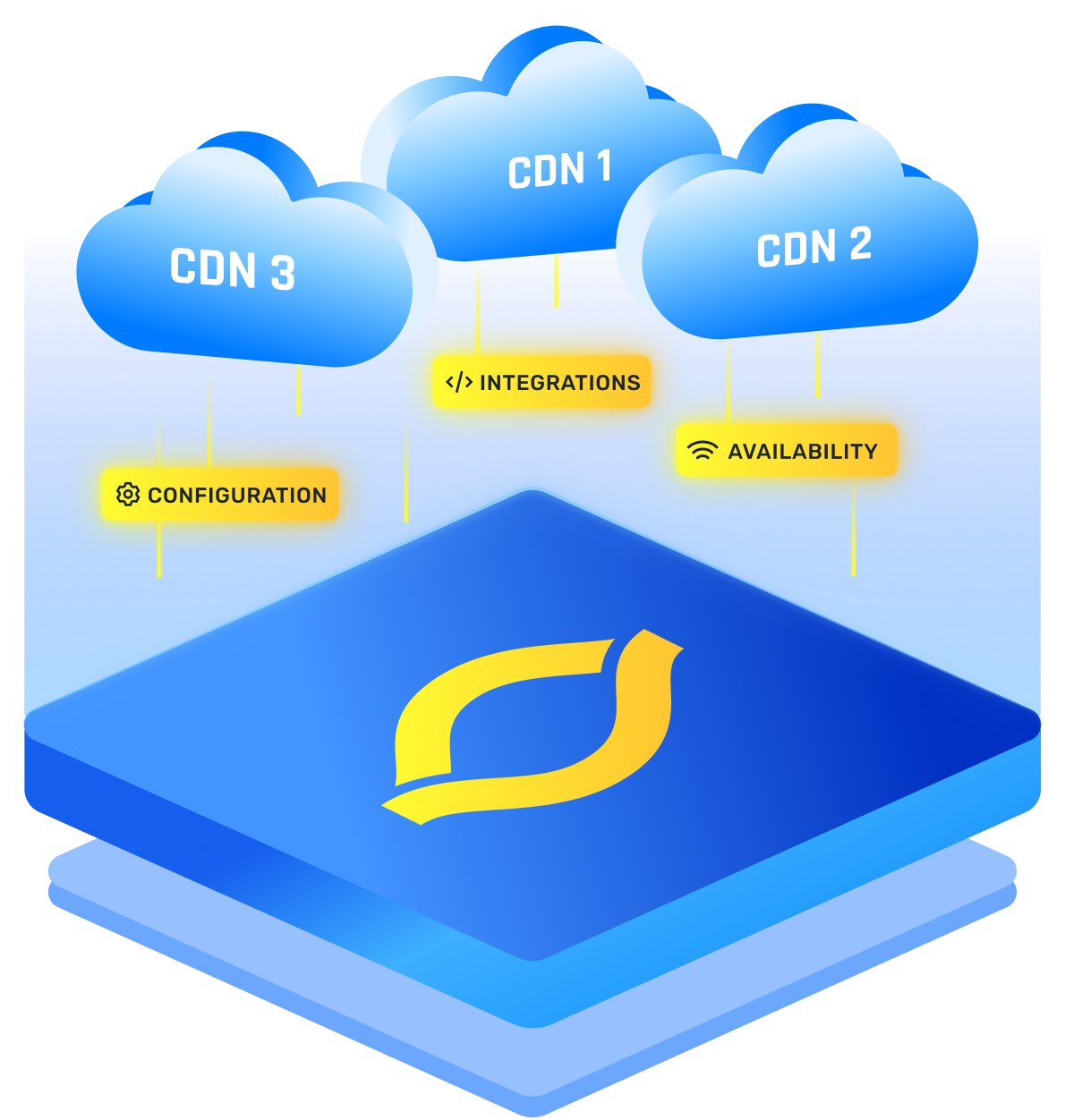

How Does Multi-CDN Improve Traffic Predictability?
Multi-CDN improves traffic predictability by shrinking the number of “unknown unknowns” that can hit your delivery layer on any given day.
- With one CDN, your traffic behavior is tightly coupled to a single provider’s routing, peering, congestion, cache behavior, and incident profile.
- With multiple CDNs, that coupling loosens. You get path diversity, failure isolation, and better signal from comparing providers side by side, so your traffic stops whipsawing from vendor-specific surprises and starts behaving inside a more reliable envelope.
In plain terms, a good multi CDN solution makes traffic more predictable because fewer things can force your whole system into a weird mode at once, and when something does get weird, it is usually localized instead of global.
Traffic Predictability Is Mostly About Variance, Not Volume
If you are asking about predictability, you are usually not struggling to guess “how many users will show up.” You are struggling to guess how the same demand turns into wildly different outcomes at the edge and at your origin.
Traffic predictability in this context is really a bundle of behaviors that you want to stay stable:
- Edge traffic shape: request rate and bytes served, broken down by region and ISP
- Origin load: how many requests leak through to your backend when caching is imperfect
- Failure-driven noise: retries, timeouts, and partial errors that inflate request counts
- Performance-driven noise: latency spikes that cause replays, longer connections, and higher concurrency
The way multi-CDN helps is not magic. It is structural. It changes how variance enters your system.
Multi-CDN Reduces Single-Provider “Coupling” That Makes Traffic Feel Random
With a single CDN, a lot of things are correlated. If that provider has an issue, the whole world sees it through the same lens. That correlation is what makes graphs look unpredictable.
With a multi CDN strategy, you introduce independence. Not perfect independence, but enough to matter. Different CDNs have different:
- Peering relationships with ISPs
- Backbone capacity and regional topology
- Cache architectures and eviction behaviors
- DDoS handling and bot policies
- Maintenance patterns and incident blast radius
Even if two CDNs both have great uptime, they rarely have the same bad day in the same way at the same time. That reduces the chance that a single event reshapes your entire traffic pattern.
A simple mental model is “correlated risk.” One provider is one roll of the dice. Two providers is still risk, but it is less likely to all land on the same unlucky face simultaneously.
What This Does To Predictability
Predictability improves because the worst deviations get capped. You still have daily variation from user behavior, but you remove a chunk of variation caused by vendor-specific network behavior.
Here’s a compact view of what changes when you add a second CDN.
Notice I am not talking about what you “should configure.” I am describing what becomes structurally true when your delivery is not a single dependency.
Multi-CDN Adds Path Diversity, So Regional Weirdness Stops Infecting Global Metrics
A big reason traffic feels unpredictable is that most problems are not global, but your monitoring and user experience might look global if your delivery is single-sourced.
Think about what actually happens in the real world:
- One ISP in one country has a peering dispute or a congested interconnect.
- A route change makes a “short path” become a “long path.”
- A metro area has a fiber cut and traffic reroutes through a longer path.
- A big event causes regional saturation at the edge.
If you only have one CDN, you have one set of paths into those networks. If those paths degrade, your traffic behavior changes in ways that look like demand shifts, even though the users did not change.
With multi-CDN, you effectively have multiple sets of roads into the same neighborhoods. That does not guarantee a perfect drive, but it makes it less likely that your entire population hits the same traffic jam at once.
The Predictability Payoff
When the delivery path is diversified, you get fewer sharp regional spikes in:
- tail latency
- timeouts
- retry volume
- “cache miss storms” driven by slow edge nodes
And because those spikes are smaller, your aggregate traffic graphs become easier to forecast. You stop seeing “random” global bumps that were actually one region exploding.
Multi-CDN Improves Predictability By Making Failures Less Chaotic
Failures create traffic noise. That is not a metaphor. It is mechanical.
When a CDN or a path is unhealthy, you often see:
- clients retrying
- apps re-requesting segments (especially video)
- browsers opening more connections
- upstream services timing out and reissuing requests
- monitoring probes amplifying load
So you can end up in a situation where demand is flat, but request counts climb. That breaks forecasts, because your “traffic” is now partially self-generated by error handling.
Multi-CDN reduces that chaos in two ways.
1) Fewer Total Outages Become “Global Modes”
When you have a single edge provider, an incident can move your entire system into a degraded state where retries become the norm.
With multiple providers, incidents are more likely to be partial, or at least not identical across providers. That lowers the probability that everything enters retry mode simultaneously.
2) Partial Degradation Becomes Containable
Even when something is wrong, multi-CDN makes it more likely that the wrongness is isolated to a subset of traffic. If only one provider has a problem in one region, the failure-driven amplification is limited to that slice, not your entire traffic surface.
This matters for predictability because forecast models hate step changes. Multi-CDN makes step changes rarer and smaller.
Multi-CDN Stabilizes Origin Load By Reducing Cache-Driven Surprises
If you have ever watched your origin graphs and thought, “Why did my backend load spike when user traffic did not,” you already met the cache unpredictability problem.
A CDN is supposed to absorb load, but cache behavior is not a constant. It changes based on:
- content churn
- popularity distribution (hot vs long tail)
- cache eviction pressure
- config changes and invalidations
- regional storage availability
- edge node health
When cache hit ratio drops, origin requests rise. That can look like a traffic surge even if you did not gain users.
Multi-CDN improves predictability here because cache behavior becomes less of a single point of failure. Different CDNs have different caching layers and different failure modes. Even if one cache layer gets stressed, the probability that all cache layers degrade the same way, at the same time, is lower.
Why This Matters For Forecasting
Most teams do not just forecast edge traffic. They forecast capacity and cost, and a lot of that depends on origin load and upstream bandwidth.
If your origin load is less likely to jump unpredictably, you get:
- more stable autoscaling behavior
- fewer emergency capacity events
- more stable database and API request rates
- cleaner separation between real demand and “cache leakage”
I am intentionally not telling you how to tune TTLs or warm caches. The point is the structural effect: multi-CDN reduces the chance that one caching system’s bad day becomes your backend’s bad day.
Multi-CDN Improves CDN Traffic Forecasting Because You Get A Control Group
This is the part many people miss. Even if you never change traffic distribution, multi-CDN can improve predictability because it improves measurement quality.
With one CDN, if performance or traffic behavior changes, you often cannot tell whether the cause is:
- user demand shift
- a change you shipped
- the CDN’s routing or edge health
- an ISP event
- a regional infrastructure issue
With multiple CDNs, you can compare. One provider becomes a reference for the other. If the same content and same users behave differently across providers, that is a strong hint the difference is delivery-layer, not demand-layer.
That makes CDN traffic forecasting better because:
- anomaly detection becomes faster
- root cause classification becomes more accurate
- your historical data becomes less “polluted” by undiagnosed vendor events
- you can build models that separate demand seasonality from delivery variance
When you are trying to forecast traffic, the hardest part is knowing which past spikes were real demand and which were artifacts. Multi-CDN reduces artifacts because it gives you differential signals.
Here’s what that looks like as a forecasting improvement.
This is one of those rare infrastructure changes that improves both engineering outcomes and analytics outcomes at the same time.
Multi-CDN Makes “Predictable Envelopes” Possible, Not Just Point Estimates
If you are forecasting traffic with one provider, you typically end up with a single estimate: “we expect X requests, Y GB.”
The issue is that real life needs envelopes:
- What happens in a normal week?
- What happens in a spike week?
- What happens when a provider has a bad day?
Multi-CDN makes envelope forecasting easier because the system has more degrees of freedom. You can reason about bounds.
Even conceptually, it changes how you talk about risk:
- With one CDN, a provider incident can force a global behavior shift.
- With multi-CDN, a provider incident is more likely to force a partial behavior shift.
So instead of planning for one giant worst case, you plan for smaller, more realistic failure cases.
This is where the phrase multi CDN switching traffic predictability comes from, even without getting into operational details.
The presence of multiple viable delivery paths changes the distribution of outcomes. Your traffic behavior has more stable bounds because the system is capable of absorbing shocks without collapsing into a single failure mode.
Multi-CDN Improves Predictability By Reducing “Reactivity Tax” In Your Systems
There is a tax you pay whenever delivery is unstable. It shows up as reactivity:
- clients retry
- load balancers see longer connections
- queues grow
- autoscalers chase moving targets
- rate limiters trigger more often
- logs and metrics volume explode
When the delivery layer is volatile, the rest of your stack becomes volatile. It is not just user experience. It is the shape of your internal traffic.
Multi-CDN helps by reducing delivery volatility, which reduces that reactivity tax.
A useful way to picture this is: your users create the base wave, and delivery incidents create the ripples. Multi-CDN does not remove the base wave, but it reduces the size and frequency of ripples.
That is why predictability improves across the entire chain, not just at the edge.
Multi-CDN Improves Traffic Stability At Scale By Avoiding “One Network Ceiling”
As traffic grows, you eventually run into scale effects that are not linear:
- a region becomes disproportionately important
- a single ISP becomes a large fraction of your user base
- content types shift (more video, larger assets)
- peak concurrency rises faster than request counts
When you are at smaller scale, one CDN can handle it with room to spare. At larger scale, you are more exposed to regional ceilings and localized saturation. Those ceilings make traffic unpredictable because the system behaves differently once certain thresholds are crossed.
Multi-CDN improves traffic stability at scale because:
- different providers have different strong regions and peering strengths
- capacity constraints are less likely to align perfectly across providers
- localized saturation on one provider does not have to become global degradation
This is not about “winning a benchmark.” It is about avoiding phase changes where your system suddenly acts different at higher load.
If you have ever seen “everything was fine until we crossed a certain peak,” you know what I mean. Multi-CDN reduces the chances that your whole delivery layer crosses the same threshold at the same time.
Multi-CDN Improves Predictability By Making Vendor Events Less Dominant In Your Data
Here is a subtle one that matters a lot if you care about planning.
CDNs have their own life cycles:
- maintenance windows
- routing adjustments
- new POP deployments
- security policy updates
- capacity expansions
- incident clusters (it happens)
In a single-CDN world, those events are baked into your traffic history. Sometimes you do not even label them, so they show up in analytics as “random anomalies.”
In a multi-CDN world, vendor events become less dominant because:
- they do not necessarily affect all traffic
- you can detect them through divergence
- you can separate them from true demand signals
That directly improves the quality of your historical data, which improves forecasting. You stop training your models on noise that you thought was reality.
It boils down to this: multi-CDN makes your system less sensitive to any one provider’s quirks, and that reduction in sensitivity is what gives you more predictable traffic, more reliable CDN traffic forecasting, and stronger traffic stability at scale.