

Why do websites load so fast, even when they’re hosted on servers thousands of miles away? That’s because of Cloud CDN; one of the biggest game-changers in web performance.
If you’ve ever streamed a video, loaded a website, or downloaded a file, you’ve already interacted with a CDN in cloud computing.
What is a Cloud CDN?
A Cloud CDN (Content Delivery Network) is a network of servers spread across different locations that delivers content to users faster. Instead of loading everything from a single server, a CDN caches copies of web content closer to users.
How It Works
- A user requests a webpage, video, or file.
- Instead of pulling it from the origin server, the CDN fetches a cached version from a nearby edge server.
- This reduces latency (the time it takes for data to travel) and improves website performance.
In simple terms, a Cloud CDN speeds up websites by reducing the distance between the server and the user.
Cloud CDN vs. Traditional CDN
While both Cloud CDN and Traditional CDN serve the same purpose; delivering content quickly, there are some key differences in how they operate.
| Feature | Traditional CDN | Cloud CDN |
|---|---|---|
| Deployment & Scalability | Hosted on physical data centers with fixed locations. | Fully integrated with cloud platforms, allowing on-demand scaling based on traffic needs. |
| Flexibility & Automation | Requires manual configuration and management. | Uses AI-driven traffic routing and automated scaling, making it more adaptive to changing conditions. |
| Cost & Efficiency | Typically involves fixed pricing, regardless of usage. | Uses pay-as-you-go pricing, meaning you only pay for what you use. |
| Security Features | Basic DDoS protection and caching. | Advanced WAF (Web Application Firewall), bot protection, and TLS encryption. |
In short, Cloud CDN is more dynamic, scalable, and cost-efficient, while Traditional CDN is more rigid and suited for fixed content delivery networks.
Why Use a Cloud CDN?
Using a CDN in cloud computing isn’t just about speed; it’s also about scalability, security, and reliability.
✔️ Faster Load Times – Content loads from the nearest server, reducing delays.
✔️ Better Scalability – CDNs can handle massive traffic spikes (e.g., viral videos, online sales).
✔️ Lower Bandwidth Costs – Reduces strain on the origin server, cutting down hosting costs.
✔️ Improved Security – Protects against DDoS attacks and other cyber threats.
✔️ Higher Availability – Even if one server goes down, content is still accessible from other locations.
Without a Cloud Storage CDN, websites rely only on a single server, which makes them vulnerable to crashes, slow speeds, and security issues.
What Does a CDN Infrastructure Look Like?
A CDN system is made up of multiple servers placed around the world, called edge servers. These servers cache (store copies of) web content so users can load it quickly.
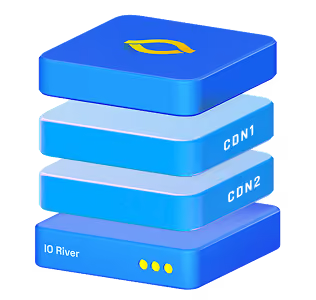
Here’s a basic CDN diagram to help visualize how it works:
📍 Origin Server → Stores the original website files.
📍 CDN Edge Servers → Spread worldwide, caching content closer to users.
📍 Users → Request content from the nearest edge server instead of the origin server.
So instead of everyone accessing a single server, users get content from the closest location, making everything load faster and reducing server strain.
How Cloud CDN Works in a Cloud Computing Environment
A Cloud CDN integrates directly with cloud platforms like AWS, Google Cloud, and Azure, providing seamless content distribution and caching. Here’s how it works:
- User Request: A user requests content (website, video, image, etc.).
- Edge Server Caching: The Cloud CDN checks if a cached version exists in the nearest edge server.
- If Cached: The content is served immediately.
- If Not Cached: The request is sent to the origin server.
- Cloud Storage CDN Integration: If content is hosted on cloud storage (e.g., AWS S3, Google Cloud Storage), the CDN fetches and caches it for future requests.
- Load Balancing & Security: The CDN distributes traffic across multiple servers, preventing overloads and blocking malicious requests.
- Response & Delivery: The user receives the content from the fastest available server, reducing latency.
Cloud CDNs leverage global cloud infrastructure to ensure high-speed, secure, and cost-effective content delivery for any platform.
How a Cloud Storage CDN Works
A Cloud Storage CDN combines content delivery networks with cloud storage. Instead of keeping files on a single physical server, it distributes them across multiple locations.
Example Use Cases:
✔️ Streaming Platforms – Netflix, YouTube, and Spotify use CDNs to serve videos and music instantly.
✔️ E-commerce Sites – Amazon and Shopify use CDNs to handle global traffic and prevent slowdowns.
✔️ Gaming Platforms – Online games use CDNs to reduce lag and improve multiplayer experiences.
✔️ Software Downloads – Companies like Microsoft and Adobe use CDNs to distribute software updates quickly.
With Cloud Storage CDN, businesses can store and deliver massive amounts of data efficiently, making everything smoother for users.
How Cloud CDN Systems Improve Website Performance
CDNs aren’t just for big companies; they help everyone. Whether you run a blog, an online store, or a news site, a Cloud CDN can dramatically improve performance.
1. Reduces Latency with Cloud Edge Servers
- Without a Cloud CDN, a user in India loading a U.S.-hosted website experiences high latency due to the long distance between the request and the origin server.
- With a Cloud CDN, content is dynamically cached on edge servers within cloud regions, ensuring users receive faster response times from a nearby node.
- Cloud-based CDNs also use smart routing algorithms to pick the fastest available path for data delivery.
2. Handles Traffic Spikes with Cloud Auto-Scaling
- Traditional CDNs often rely on fixed infrastructure, which may struggle with unexpected traffic surges.
- Cloud CDNs, however, auto-scale based on demand, dynamically provisioning more edge servers when traffic spikes.
- This prevents downtime and ensures your website stays fast even during peak loads (e.g., Black Friday sales, viral content, or global events).
3. Enhances Security with Cloud-Based Protection
- Cloud CDNs offer built-in security features like DDoS protection, Web Application Firewalls (WAF), and bot mitigation, preventing malicious traffic from ever reaching your server.
- Since Cloud CDNs operate within cloud environments, they benefit from AI-driven threat detection, automatically identifying and blocking suspicious activity across the network.
- End-to-end TLS/SSL encryption ensures secure data transfer between the origin server, CDN nodes, and users.
4. Saves Bandwidth Costs with Smart Caching & Compression
- Cloud CDNs reduce the load on origin servers by serving cached content, minimizing requests to cloud storage or backend databases.
- Advanced compression algorithms (like Brotli & Gzip) further reduce data size, leading to lower bandwidth costs.
- Cloud providers also offer cost-efficient pricing models, ensuring you only pay for the bandwidth you actually use.
CDNs about making websites more reliable, secure, and cost-effective.
Cloud CDN Pricing and Cost Considerations
Cloud CDNs are not always cheaper than traditional CDNs. The pricing model is different, and which one wins depends on your traffic pattern, location mix, and how well you cache.
Cloud CDNs often use pay as you go pricing. You pay for:
- Data transferred out to the internet
- Requests or operations
- Extra features like WAF, log streaming, or advanced routing
This fits you well if traffic is spiky, seasonal, or still growing, because you avoid long contracts and can shut things off when you do not need them.
A Cloud CDN often beats a traditional CDN in cost when:
- Your traffic is moderate or unpredictable
- Most of your origin content already lives in the same cloud provider
- You do a good job on cache hit ratio, so origin egress stays low
You also save some hidden costs, such as lower egress from cloud storage to the provider CDN, and less engineering time for deep integration.
A traditional CDN can be cheaper if:
- You push very large, steady volumes and can commit to a contract
- You negotiate strong discounts for multi year and multi region traffic
- You move traffic from multiple clouds and on premises origins, so no single cloud CDN gets a natural egress discount
In that case, a per Mbps or large per GB contract with a traditional provider can beat pay as you go rates from a cloud CDN.
To work out which one costs less for you, ask:
- Where does most of your origin traffic live now
- How much of your traffic is cacheable versus dynamic
- Whether you prefer flexible spending or fixed commits for better discounts
The right answer is not that Cloud CDN is always cheaper or that traditional CDN is always cheaper. The winner is the one that matches your traffic shape, origin location, and caching strategy.
Cloud CDN Architecture & Edge Network
A Cloud CDN architecture consists of multiple components working together to optimize content delivery. Here’s how it’s structured:
📍 Origin Server – Stores the original content (website, app, or media files).
📍 Cloud Storage CDN – Keeps static files and media cached in the cloud.
📍 Edge Servers – Distributed globally to serve content closer to users.
📍 Load Balancer – Distributes traffic across multiple servers to prevent overload.
📍 Security Layer – Includes firewalls, DDoS protection, and SSL encryption.
📍 Cache Invalidation – Automatically updates content when changes are made.
The Edge Network is what makes Cloud CDN powerful; it ensures users always get content from the nearest, fastest, and most secure server.
With multiple data centers worldwide, a Cloud CDN minimizes delays, improves security, and optimizes bandwidth usage.
How to Choose the Right Cloud CDN
Not all CDNs are the same. Here’s what to look for when choosing a Cloud CDN:
✅ Global Coverage – More edge servers mean faster load times worldwide.
✅ Security Features – Look for DDoS protection, SSL encryption, and bot mitigation.
✅ Integration with Cloud Services – Works with platforms like AWS, Google Cloud, or Azure.
✅ Scalability – Handles sudden traffic spikes without crashing.
✅ Analytics & Monitoring – Provides insights on traffic, performance, and security threats.
Some of the biggest CDN providers include Cloudflare, AWS CloudFront, Akamai, and Google Cloud CDN.
Cloud CDN Limitations and Trade Offs
A Cloud CDN can make your site much faster, but it is not a magic button. Dynamic or personalized pages are harder to cache, so you still depend on your origin.
Cold caches slow down first requests. You also add a layer that can fail, needs observability, and ties you more tightly to a provider and its pricing.
| Limitation | What It Means | How You Can Handle It |
|---|---|---|
| Hard to cache dynamic content | Highly personalized pages or fast changing data cannot always sit in edge cache, so some requests still hit origin heavily. | Split pages into static and dynamic parts, cache what you can, and keep APIs and databases tuned. |
| Cold cache and warm up time | New regions or new content start with empty cache, so early users feel higher latency until the edge fills. | Pre warm important paths, use sensible TTLs, and watch cache hit ratios in new markets. |
| More moving parts to debug | You now have browser, CDN, and origin in the path, which can make issues harder to trace. | Use good logging and monitoring on both CDN and origin, and test changes in stages. |
| Provider dependence and lock in | Deep use of one CDN and its features can make it harder or costly to switch later. | Avoid very provider specific features where possible, and design with a multi CDN or migration path in mind. |
Conclusion
A Cloud CDN is essential for fast, reliable, and secure content delivery. It improves speed, security, and scalability by caching content on multiple edge servers worldwide.
With the right CDN infrastructure, you can ensure your website loads instantly; no matter where your users are.
FAQs
How does a cloud content delivery network improve website speed and reliability?
A cloud content delivery network speeds up your site by caching pages, images, and files on edge servers close to your users. Requests do not travel back to a distant origin each time, so latency drops. It also adds redundancy, so if one node fails, another can still serve traffic.
What are the main advantages of using CDN networking in cloud architecture?
Using CDN networking cloud architecture lets you push static and dynamic content out to many edge locations while keeping control in your cloud stack. You get shorter paths to users, easier integration with storage and compute, and built in security features that wrap around your existing services.
How do distributed CDN systems handle traffic spikes and regional demand?
A distributed CDN spreads your content across many edge servers in different regions. During traffic spikes, load balancing sends users to less busy nodes, and auto scaling in the cloud brings extra capacity online. This combination lets the system absorb sudden demand without crashing or slowing dramatically.
What differentiates a cloud CDN from a traditional content distribution network?
A cloud CDN is a type of content distribution network that runs on top of cloud platforms. Traditional CDNs rely more on fixed hardware and long contracts. Cloud CDNs usually offer pay as you go billing, closer integration with storage, and faster automation for routing and security.
How can businesses optimize performance using a CDN content delivery network for global audiences?
To optimize performance with a CDN content delivery network, start by caching as much static content as you safely can, then tune cache keys and TTLs. Place origins in regions that match your audience, enable compression, and use real user monitoring to see where edge performance still needs work.


