
Reflection Attacks: How Attackers Amplify DDoS Traffic Using Your Own Infrastructure
Learn how reflection attacks amplify DDoS traffic, exploit IP spoofing, and overwhelm networks with indirect traffic floods.

Your network can be patched and watched closely, yet still get dragged into a fight it never joined. One minute, everything looks normal. The next, thousands of real systems are suddenly talking to you at once.
That is the strange part of reflection attacks. The traffic often comes from innocent servers. The attacker hides behind them, like someone ringing your doorbell and sending the neighborhood to answer it.
Key Takeaways
- Reflection attacks use third party systems to send traffic toward a victim.
- Attackers often rely on an IP spoofing attack to make replies go to your address.
- Amplification makes the attack worse because a small request can create a large reply.
- A DNS amplification attack is common because open DNS resolvers can send large responses.
- A UDP flood attack and a reflection attack can look similar from the victim side.
- A DDoS protection service helps because the flood often needs upstream filtering.
What Reflection Attacks Are And Why They Work So Well Against Unprepared Networks
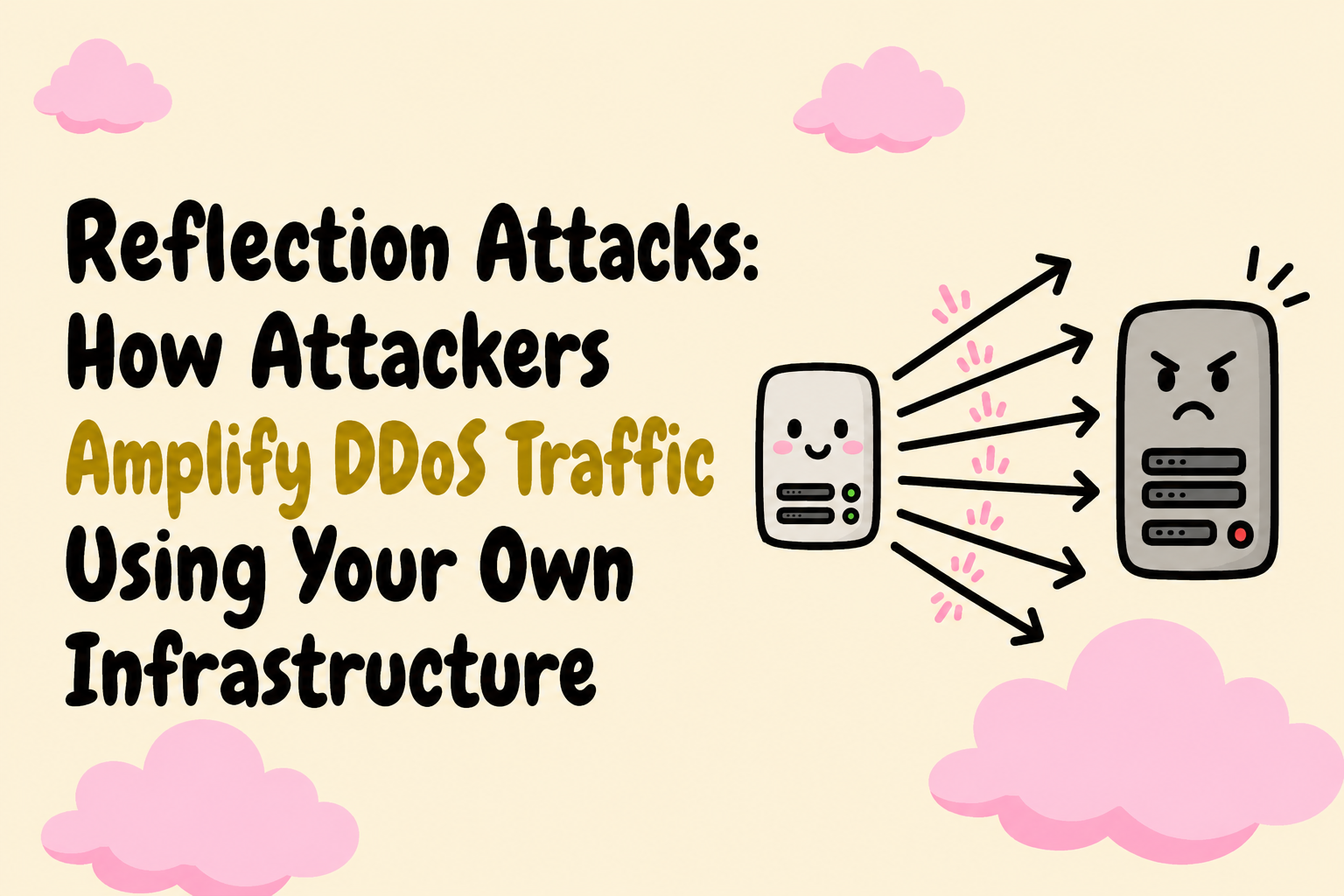
A reflection attack is built on a simple trick. The attacker sends a request to an exposed service, but they fake the source IP address. Instead of putting their own address in the packet, they put yours. The service thinks you made the request, so it sends the reply to you.
That fake source address is the heart of the IP spoofing attack. Your server did not ask for the reply, but it still has to deal with it. Now imagine that happening through thousands of exposed services at the same time. That is when a nuisance becomes a DDoS problem.
- The attacker sends small forged requests.
- The reflectors send larger replies to your network.
This works so well because many internet services are built to answer quickly. UDP services are especially attractive because they do not need a full connection before they reply. That saves time for normal users, but it also gives attackers a shortcut.
The real damage comes from scale. One reply may not matter. A wall of replies can fill your bandwidth and tire out your firewall while the server itself still looks healthy.
{{promo}}
The Protocols Attackers Exploit Most And Why They Are Still Open
Attackers usually look for services that answer strangers and send replies bigger than the request. DNS is the best known example. In a DNS amplification attack, the attacker sends DNS queries with your IP address forged as the source. Open resolvers answer you, not the attacker.
DNS is useful to attackers because it is everywhere. It is also designed to be helpful. When a resolver is left open to the whole internet, that helpful behavior can be abused. Large DNS answers can turn small requests into much heavier traffic.
- DNS recursion should answer only trusted clients.
- Authoritative DNS should be watched for unusual query spikes.
Other protocols have also been abused in reflection attacks. NTP, CLDAP, SSDP, SNMP, and memcached have all caused trouble when exposed to the public internet. Many were never meant to be open to everyone. They ended up that way because of weak defaults, old devices, rushed changes, or forgotten firewall rules.
There is a useful rule here. If a public service answers a stranger without checking much, ask why it is public. That may feel boring, but boring questions often save you from exciting outages. In security, “exciting” is rarely a compliment.
What A Reflection Attack Looks Like From The Victim's Side
From your side, a reflection attack can look confusing. You may see traffic from real DNS servers, hosting networks, cloud services, or office routers. These systems are not always attacking you on purpose. Many are simply replying to forged traffic.
That makes the first few minutes difficult. Your logs show many sources, but blocking each one may not help much. The attacker has turned normal infrastructure into cover.
- You may see a sudden rise in UDP traffic from one source port.
- Your server CPU may look fine while users still see timeouts.
This is where a reflection attack can feel like a UDP flood attack. In both cases, your network is hit by large amounts of unwanted UDP traffic. The difference is the path. In a direct UDP flood attack, the traffic often comes from attacker controlled systems. In reflection attacks, the visible senders are usually reflectors.
The most important clue is where the pain starts. If your bandwidth is full before traffic reaches your server, local tuning will not fix the full problem. Your firewall may be doing its job, but your internet link is still choking. A firewall is useful, but it is not a magician.
Why Traditional DDoS Defenses Often Miss Reflection Traffic
Traditional defenses often work best when the bad source is easy to name. You block an IP or add a rate limit. That can help with simple abuse. Reflection traffic is harder because the visible sources may be normal systems spread across many networks.
IP based rate limiting can also struggle. The attack may come from thousands of reflectors, each sending a smaller slice of the flood. The combined traffic still hurts badly.
- Blocking too many reflector IPs can block real users too.
- Filtering at your own edge may be too late if the link is already full.
This is why upstream help matters. If the attack fills the path between your provider and your network, your firewall only sees the mess after the damage has started. You need filtering closer to the larger pipes.
A DDoS protection service can help by absorbing and cleaning traffic before it reaches your smaller network path. It can spot protocol patterns and pass cleaner traffic to you after dropping junk.
{{promo}}
How To Harden Your Infrastructure Against Being Used As A Reflector And A Target
You need to protect yourself in two directions. First, do not let your systems become reflectors. Second, prepare for the day someone else’s reflectors are pointed at you.
Start with exposure. Look at every public UDP service and ask whether it must be open to the world. If the answer is no, restrict it. If the answer is yes, limit it, monitor it, patch it, and document it.
- Disable open DNS recursion unless it is meant for trusted users only.
- Block public access to SNMP, SSDP, memcached, and old NTP commands.
You should also watch outbound traffic. If your server suddenly sends many large replies to one destination, it may be acting as a reflector. That is bad for the victim and your reputation. Nobody likes getting that abuse ticket.
As a target, build baselines. Know your normal traffic levels, common protocols, packet rates, and busy hours. During reflection attacks, “this looks weird” is useful, but “UDP source port 53 is ten times higher than normal” is better.
- Keep an emergency contact path with your ISP or hosting provider.
- Use Anycast or a DDoS protection service for services that must stay online.
Also ask your provider about source address validation. Reflection attacks rely on spoofed source IP addresses. When networks block packets that claim to come from addresses they should not be sending, attackers lose an important tool.
Finally, write a short runbook. Include who to contact, what logs to capture, what traffic patterns matter, and when to move traffic behind protection. Your team should not invent the plan while users refresh a broken page.
Conclusion
Reflection attacks work because they twist normal internet behavior. A service receives a request. It sends a reply. The attacker changes the source address, and suddenly that normal reply becomes part of a flood.
- Close services that should not be public.
- Clean attack traffic before it reaches your edge.
You cannot close every reflector on the internet. You can close your own open doors, watch for suspicious replies, prepare upstream filtering, and use a DDoS protection service where uptime matters.
FAQs
What Is The Difference Between A Reflection Attack And An Amplification Attack?
Reflection is about direction. The attacker tricks another system into sending traffic to you. Amplification is about size. The reply is larger than the request. Many real attacks use both together, so a small forged request can turn into a much larger flood aimed at your network.
Can A Reflection Attack Be Traced Back To The Actual Attacker?
Sometimes, but it is difficult. The traffic you see usually comes from reflectors, not the attacker. Tracing the real source needs help from upstream providers and logs closer to where the spoofed traffic began. Without that cooperation, you may only see the innocent systems being abused.
Is DNS The Most Dangerous Protocol For Reflection Attacks Or Are There Worse Ones?
DNS is one of the most common because it is widely used and often exposed. It is not always the worst by amplification size. NTP, CLDAP, SSDP, SNMP, and memcached can also be dangerous when left open. Your real risk depends on what is exposed and how attackers can abuse it.
How Do Reflection Attacks Get Around IP Based Rate Limiting?
They spread traffic across many reflectors. Each source may send only part of the flood, so a basic limit per IP may not trigger fast enough. If you block too broadly, you may also block real networks. Protocol filtering and upstream scrubbing usually work better than simple IP rules.
At What Traffic Volume Does A Reflection Attack Typically Become Service Impacting?
There is no single safe number. A small site can suffer at traffic levels a larger network would barely notice. The real threshold depends on your bandwidth, firewall capacity, provider path, and normal traffic baseline. If the flood fills your link, even a healthy server can look offline.